
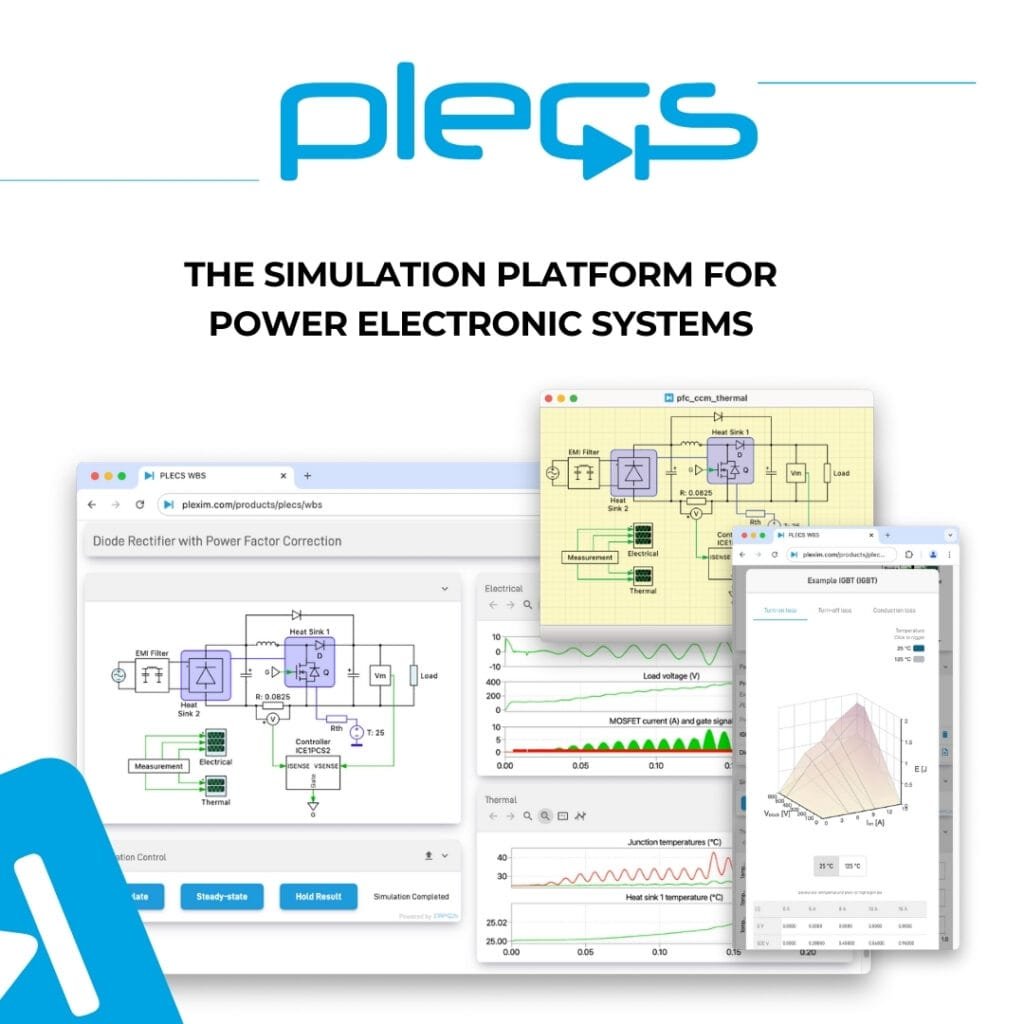
Why PLECS is the Industry Standard for Power Electronics Simulation
At the core of modern electrification lies the power converter. Whether designing an EV traction inverter, a renewable energy grid-tie system, or a high-speed GaN-based charger, engineers require a power electronics simulation environment that balances speed with extreme accuracy. While many engineers start with MATLAB Simulink or SPICE-based tools, they often hit a “performance wall” when moving to high-frequency applications.
This is where PLECS (Piecewise Linear Electrical Circuit Simulation) has emerged as the industry benchmark. Unlike generic time-domain simulators, PLECS Standalone and PLECS Blockset (for MATLAB/Simulink integration) are purpose-built to handle the discrete, non-linear nature of switching power electronics. By prioritizing event-based execution over fixed time-steps, PLECS eliminates the common stability issues found in traditional solvers, making it the go-to choice for Silicon Carbide (SiC) and Gallium Nitride (GaN) power stage design.
The Limitations of Traditional Power Electronics Simulation Tools
A fixed time-step view represents the world as discrete slices of time, which may be appropriate for continuous time-domain simulations, but it becomes excessive and often very unstable for power converter PWM simulations, in which the major performance aspects occur at switching transitions.
Costs associated with using fixed time-steps
The fixed time-step method must be used with many of the PWM converters. Switching edge resolution requires time-steps that are generally much smaller than the switching period. Also, due to the rapidly increasing switching frequency, the time-step continues to decrease, leading to a very high computer cost that grows exponentially for studies lasting longer than the startup time, thermal settling, grid excursion, or ride through.
Introduction of numerical artifacts
With the introduction of fixed time-steps, ripple and oscillations that appear to be physical ringing are often numerically induced. As engineers diagnose EMI manifestations, current overshoots, and gate drive timing, they may reach erroneous conclusions.
- Timestep dependency: Results change when you change the timestep.
- Edge smearing: Switching transitions blur unless the timestep is extremely small.
- Runtime wall: Long simulations at high frequency become unmanageable.
Understanding Event-Based Power Electronics Simulation
Event-based simulation treats switching events as first-class citizens. Instead of pushing time forward in uniform increments, the simulator detects events (switch state changes, diode commutation, comparator toggles) and computes the system behavior between those events.
Piecewise-linear behavior between events
Between switching events, many power electronics networks behave linearly (or can be represented effectively by piecewise-linear segments). The solver can therefore compute responses efficiently and precisely until the next event occurs.
This is the core reason PLECS simulation is widely recognized for fast yet stable results in switching frequency simulation and event-based simulation for power electronics.
High switching frequency is where generic tools often break down. Wide-bandgap devices increase dV/dt and di/dt, while modern control strategies push higher PWM frequencies for improved dynamic performance and power density.
- Accurate switching instants without timestep-induced oscillations: In an event-based framework, switching instants are captured explicitly. Engineers can observe realistic turn-on and turn-off behavior, commutation sequences, and transient currents without the simulation itself injecting artifacts.
- Long-duration performance: Because the solver does not waste work on “empty time” between events, longer simulations become more practical. This matters for verifying startup sequences, protection behavior, or thermal dynamics on realistic time scales.
Where this shows up: EV inverter simulation software evaluations, fast switching device simulation, and debugging control interactions at high PWM frequencies.
Power Electronics–Focused Modeling Philosophy
Unlike traditional generic simulators with a “Power Electronics” module, PLECS was purposely built for the power electronics industry. This means that its model structure and workflow are fully compatible with the various tasks associated with designing power converters.
Engineering usability
- Converter-centric building blocks and clear parameterization.
- Workflows that support rapid iteration (topology, PWM strategy, device choice).
- Practical analysis outputs aligned with design decisions.
- Accurate switching instants without timestep-induced oscillations: In an event-based framework, switching instants are captured explicitly. Engineers can observe realistic turn-on and turn-off behavior, commutation sequences, and transient currents without the simulation itself injecting artifacts.
- Long-duration performance: Because the solver does not waste work on “empty time” between events, longer simulations become more practical. This matters for verifying startup sequences, protection behavior, or thermal dynamics on realistic time scales.
Where this shows up: EV inverter simulation software evaluations, fast switching device simulation, and debugging control interactions at high PWM frequencies.
Semiconductor Device Modeling (IGBT, MOSFET, SiC, GaN)
Accurate semiconductor modeling is central to predicting losses, efficiency, and device stress. Modern platforms must cover silicon IGBTs and MOSFETs while also supporting SiC and GaN device simulation for high-frequency, high-efficiency designs.
Why device modeling matters:
- Conduction losses drive thermal performance at high current.
- Switching losses dominate as switching frequency rises.
- Temperature effects shift parameters and stress margins.
In real engineering work, the goal is not a “perfect physics model,” but an accurate-enough representation that supports design decisions, risk reduction, and faster convergence toward hardware that works.
Magnetics, Passive Components, and Non-Ideal Effects
A converter is only as accurate as its non-idealities. Inductor saturation, winding losses, capacitor ESR/ESL, busbar resistance, and stray inductance all shape real waveforms and EMI signatures.
- Inductor saturation during load steps.
- Capacitor ESR heating and ripple voltage.
- Stray inductance driving overshoot and ringing.
- Core losses affecting thermal rise and efficiency.
PWM Converters, Multi-Level Inverters, and Fast Transient Analysis
PWM converter simulation is where solvers are truly tested: hard switching, dead-time, diode recovery, and fast current transitions can all occur within a few tens of nanoseconds—while system-level behaviors unfold over seconds.
Multi-level inverter simulation
Multi-level topologies introduce more switching states, more commutation paths, and more opportunities for subtle timing-related issues. An event-based approach helps capture these state transitions cleanly, supporting topology evaluation, control tuning, and stress analysis.
Fast transient analysis
Real systems must survive faults and abnormal modes. Engineers use simulation to examine fault currents, protection timing, and recovery behavior—areas where numerical artifacts can be costly if they mislead diagnosis.
Simulation Speed vs Accuracy: A Practical Engineering Perspective
Engineers rarely choose between speed and accuracy by preference; they do it under schedule pressure. A tool that is stable and fast reduces the need for constant timestep tuning and repeated reruns.
What “fast enough” really means:
- Fast iteration for design exploration and control tuning.
- Long simulations to validate sequences and thermal behavior.
- Repeatability across parameter sweeps and what-if studies.
Applications Across EVs, Renewables, Motor Drives, UPS, and Research
- EV powertrain and inverter design: EV traction inverters and onboard chargers demand high efficiency, compact magnetics, and robust controls across fast transients. PLECS is commonly evaluated as an EV inverter simulation software platform because it supports switching-accurate behavior and converter-centric workflows.
- Renewable energy systems: Grid-tied converters need credible transient response, protection verification, and stable control interaction. Simulation helps verify ride-through behavior, PLL response, and current control under disturbances.
- Motor drives and industrial power: Drives and servo systems depend on PWM quality, current regulation, and dynamic performance under load steps. Accurate switching behavior helps predict current ripple, torque ripple, and thermal stress.
- Academic research and teaching: Researchers value simulation environments that remain stable while exploring novel topologies, wide-bandgap switching, and high-performance control techniques—without spending days tuning numerical settings.
Why PLECS Is Considered the Industry Benchmark
PLECS is often called the benchmark because it aligns tightly with the realities of power converter design: switching events matter, numerical stability matters, and engineering productivity matters.
- Event-based simulation that captures switching behavior precisely.
- High-frequency stability without timestep-induced artifacts.
- Power-electronics-focused modeling that matches real workflows.
- Practical performance for long-duration and parameter-sweep studies.
| Feature | PLECS Standalone | PLECS Blockset |
|---|---|---|
| Platform | Runs independently (Windows, macOS, Linux). | Requires MATLAB & Simulink. |
| Simulation Engine | Optimized solvers (DOPRI, RADAU). | Simulink solver engine. |
| Speed | Faster. No Simulink overhead. | Slightly slower due to communication. |
| Control Modeling | Built-in PLECS control blocks. | Full Simulink ecosystem. |
| Cost | PLECS license only. | PLECS + MATLAB + Simulink. |
| Portability | Shareable via free PLECS Viewer. | MATLAB/Simulink required. |
| Data Processing | Built-in plotting & scripting. | MATLAB toolboxes. |
Conclusion: When Accuracy and Speed Matter, Engineers Choose PLECS
To achieve useful results from power electronics simulation, the platform must be both reliable and user-friendly. As the maximum switching frequency of a converter increases, traditional fixed time-stepping methods often become less reliable due to computational slowdowns and numerical instability.
Plexim has successfully addressed these challenges by implementing an event-based, piecewise linear model. This approach ensures that your power electronics simulation remains stable and accurate, even when simulating complex topologies over long durations. By choosing a tool specifically optimized for power electronics simulation, engineers can focus on design innovation rather than troubleshooting numerical artifacts.
Note: Plexim’s sole developer and authorized distributor for India is Pantronic India Pvt Ltd. They offer all the necessary support, training, and assistance for both simulation of Power Electronics devices and testing of Power Electronics devices.
Ready to overcome the performance wall in your power designs? Don’t let numerical artifacts and simulation lag slow down your development cycle. Whether you are transitioning to SiC/GaN or optimizing a multi-level inverter, our team at Pantronic India Pvt Ltd is here to help. Reach out to us today for a technical consultation or a guided demo of PLECS Standalone and Blockset. Let’s accelerate your path from simulation to hardware.
Frequently Asked Questions
PLECS is used to model, simulate, and analyze power electronic systems such as inverters, converters, motor drives, and power supplies. It focuses on accurate switching behavior, loss calculation, and control interaction, making it suitable for both industrial design and academic research.
Traditional simulators rely on fixed timesteps, which can introduce numerical errors at high switching frequencies. PLECS uses event-based simulation, capturing switching events exactly and solving the system analytically between events for improved stability and speed.
Yes. PLECS is specifically designed for high-frequency power electronics. Its event-based approach avoids timestep-related inaccuracies and remains stable even when simulating fast-switching SiC and GaN devices.
PLECS supports detailed modeling of SiC and GaN devices, including switching losses, conduction losses, and temperature effects. Engineers can base models on datasheet curves while maintaining numerical stability during fast switching transitions.
PLECS is widely used for EV traction inverters, onboard chargers, DC-DC converters, and renewable energy inverters. Its ability to simulate real switching behavior makes it suitable for both development and validation in these applications.
Yes. PLECS supports simulation of multi-level inverter topologies such as NPC, ANPC, flying capacitor, and modular multilevel converters, including detailed switching and control interactions.
By solving the system only when events occur, PLECS avoids unnecessary calculations. This event-based approach improves numerical stability and allows long-duration simulations to run faster than fixed-timestep methods.

Expert Technical Support
In my discussions with Indian R&D teams, the question isn’t whether the software works—it’s whether the simulation matches the oscilloscope. My goal at Pantronics is to ensure your virtual results are a 1:1 reflection of your laboratory hardware. We don’t just provide a tool; we provide the certainty that your design is robust
Mr. V. N Sudharsan (Technical specialist)
Mail ID: sudharsan@pantronicsindia.com