
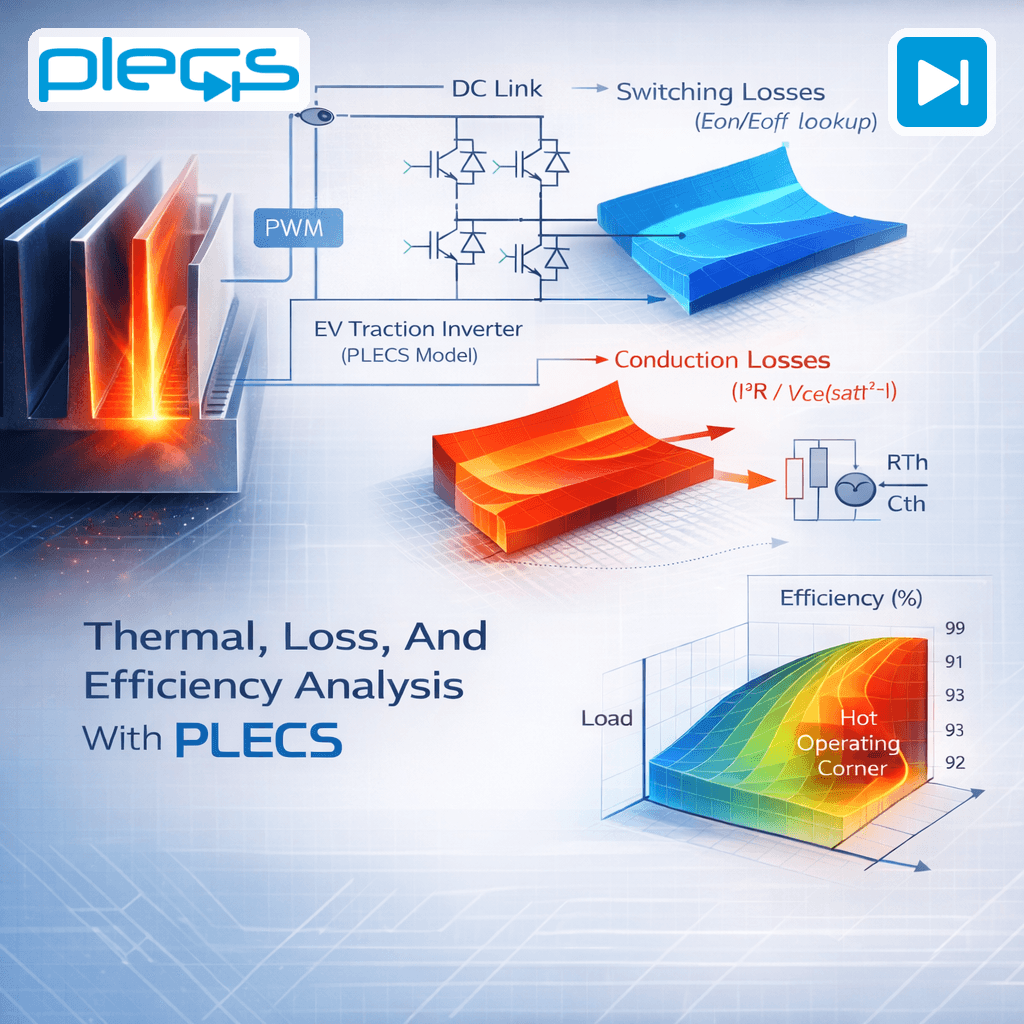
Most modern power electronics design requires consideration of thermal stress and efficiency as the critical design parameters. In the case of an EV traction inverter, an AC-DC charger or AC-DC interface inverter, a large-power motor drive or industrial DC-DC converter or inverter drive, the ultimate limitations of the converter are defined by:
- Total electrical loss, comprising semiconductor losses, passive component losses, and interconnect losses.
- The maximum temperature rise at the junction and severity of thermal cycling.
- The available cooling solutions (heat sink, cold plate, or air/liquid loop and thermal interface materials).
- Reliability margins when using representative operating profiles.
Timing is a significant issue: many teams discover thermal problems at later stages of the design cycle, often after building the hardware to final specifications; then, upon measurement, they observe greater than expected switching losses, excessive hot spots on the device, or inadequate cooling margins.
The objective of using PLECS thermal simulation is to help identify these issues as early in the design cycle as possible by allowing for simultaneous electrical loss calculation, thermal network modeling, and efficiency evaluation to be conducted in one consolidated workflow.
Relationship Between Electrical Losses, Temperature, And Reliability
A thermal design engineer views reliability as closely associated with temperature and thermal cycling, both of which are influenced by loss mechanisms.
Electrical losses create heat
- For high-current applications, conduction losses (I²R, Vce(sat)·I, and diode drops) are most prevalent.
- Switching losses increase with an increase in switching frequency as well as an increase in dv/dt/di/dt.
- In some switching topologies, reverse recovery losses or dynamic loss mechanisms may dominate.
Temperature impacts electrical performance
- Rds(on) typically increases with junction temperature, increasing conduction loss.
- Switching behavior shifts with temperature, moving switching loss curves.
- Safe operating area shrinks, increasing derating and reducing lifespan.
Loss Modeling Capabilities In PLECS
To perform thermal validation at the early stage of product development, it is crucial to develop an accurate model that will provide enough precise information to enable making good decisions, while still being practical to implement.
PLECS allows for an efficient calculation of losses that maintains an ideal switching state in the electrical simulation, thereby not adversely affecting overall simulation speed because of the loss calculation process.
plexim.com
This is significant because engineering teams often require:
- Expansive envelope sweeps of operations
- Long-term testing related to starting up, drift effects, and load profiles.
- Differentiation across various device technology types, including Si, SiC, and GaN.
(Conduction losses, switching losses, temperature dependency)
Thermal Performance of Power Electronics is Dominated by the Semiconductor Losses. PLECS has created a Semiconductor Loss Calculation Procedure specific to Power Electronics
Switching Loss Calculation (Event Based Power Accounting)
PLECS does not calculate switching losses by calculating the instantaneous loss using high-resolution voltage/current measurements collected while in operation. Rather, PLECS records the operating conditions at the time of each switching event, including the forward current, blocking voltage, and junction temperature. PLECS then utilizes that information to look-up the switching energy dissipated in a 3D-data lookup table.
Why This Approach is Appropriate:
Avoidance of needing to collect high-resolution transient data purely for loss calculations.
The methodology translates easily to how semiconductor switching energy is typically presented in datasheet values. (Eon/Eoff vs I,V,Tj)
The temperature-dependence is also integrated into the 3D-data lookup table.
Conduction Loss Calculation (Current + Temperature Dependence)
When the device is in operation, PLECS calculates the power dissipated when the device supports current and temperature.
This Capability Enables:
The ability to evaluate conduction heating realistically when a device is under a heavy load and supports Electro-Thermal Iteration because of how a device’s temperature impacts its Operating Point.
Importance of Temperature Dependence
Several datasheets show temperature dependence in the semiconductor’s switching losses (increasing exponentially with increasing junction temperature). PLECS includes the ability to add multiple temperature data tables and make use of temperature dependent switching loss curves in their datasheets in PLECS Tutorials.
Datasheet-Based Curve Fitting And Parameter Extraction.
Thermal and loss modeling lives or dies on how quickly engineers can translate datasheet information into simulation-ready models—especially when vendor “full models” aren’t available.
PLECS provides workflows that teach and support:
- extending a switch thermal model with conduction loss and thermal impedance data
- importing curves using built-in tools (e.g., curve import workflows)
- building combined electrical-thermal simulations that compute junction temperature, losses, and efficiency .
From a real engineering perspective, this is where confidence is built:
- you can start with manufacturer curves (Eon/Eoff, V-I, Zth curves)
- you can refine fidelity over time
- you can run comparative studies early, even before device samples arrive
Thermal Network Modeling In PLECS
To characterize the thermal behavior of power converters, it is common practice to use thermal networks. PLECS allows users to model heat conduction as a system of thermal resistances / thermal capacitances connected to heat sinks, which allows users to decide how much detail will be included in the model when designing their power converters.
By allowing users to select the appropriate level of detail, the value of this type of model lies in its practical application.
There are only three types of thermal networks that are relevant in practice:
- Fast junction-to-case thermal dynamics
- Medium case-to-sink thermal dynamics
- Slow sink-to-ambient thermal dynamics
Therefore, there is no need to use complete Computational Fluid Dynamics (CFD) to determine the thermal feasibility of a particular power converter, to evaluate if the size of a heat sink is adequate, or to determine if a cooling strategy must be modified
Modeling Heat Sinks, Cooling, And Thermal Interfaces
In real systems, thermal performance is rarely set by the semiconductor alone. It’s the entire thermal stack:
package → baseplate → thermal interface material (TIM) → heat sink/cold plate → ambient or coolant.
PLECS models this using the Heat Sink as a fundamental thermal boundary and allows heat conduction paths to ambient or between heat sinks using lumped R/C networks.
A concrete example from a Plexim application model illustrates:
- a heat sink representing thermal capacitance that collects switching energy and conduction power.
- thermal RC chains representing case propagation.
- an Ambient Temperature component connecting the system to an external heat sink/dissipator.
Why this matters for design.
Thermal interfaces and cooling choices often drive BOM cost and mechanical constraints. Early electro-thermal simulation helps you avoid:
- oversizing heat sinks “just to be safe”
- choosing expensive cooling when a better device choice would suffice
- discovering too late that TIM resistance dominates your thermal budget
Electro-Thermal Co-Simulation And Temperature Feedback
Electro-thermal modeling becomes truly valuable when temperature is not treated as a static assumption.
Plexim’s PLECS software allows simultaneous operation of electrical (i.e., circuit) and thermal simulations. However, in PLECS, thermal components are defined in a separate but related domain to circuit simulations.
An application example for Plexim PFC shows how the thermal structure transmits information regarding temperature back to the chip, allowing precise loss predictions. In so doing, it demonstrates how thermal and loss computations relate to one another within the modelling system.
The importance of temperature feedback in a practical sense
Temperature dependence of switching losses
- The temperature level affects the conduction loss in numerous different devices.
- Thermal transients (short bursts and overloads), even with stable average sink temperatures, can lead to junction spikes.
Electro-thermal coupling provides engineers with confidence that their calculations of what is “Efficiency” are not based upon unrealistic temperature assumptions.
Efficiency Mapping And Operating Point Analysis
Converter efficiency is not a single number—it is a surface across load, speed, modulation index, DC-link voltage, and temperature.
PLECS tutorials show how to compute converter efficiency once losses are known, using averaged input power and total loss signals to calculate efficiency over time.
In practical engineering workflows, this expands into:
- efficiency mapping across operating points
- assessing “hot operating corners” where temperature rise is highest
- comparing design variants (devices, switching frequency, modulation, cooling)
Long thermal time constants mean that steady-state analysis is important
Thermal time constants can take hours or even days to settle compared with electrical switching. An example provided by Plexim illustrates this issue; a full time simulation that includes thermal transients will have to wait until the thermal transients have settled out before the user can view the final temperature distribution of the components. plexim.com
For real projects, this is extremely important; you will frequently want to obtain the following information:
- Temperature at steady-state junction temperature for continuous duty point
- Quickly find temperature, with respect to junction temperature, for multiple cycle scenarios without running full time simulations for multiple hours.
Design Optimization Using Thermal And Loss Insights
By using power electronic loss analysis as a design tool instead of a post-processing step, you can:
Select the optimal power semiconductor device family and package based on:
Electro-thermal simulation comparisons of power semiconductor device families, along with tradeoffs for switching frequency and gate drive strategies that impact switching energy
Evaluation of Si, SiC, and GaN technologies
- Silicon: Typically utilized due to lower cost, but has higher switching losses at high frequencies.
- Silicon carbide: Has high-voltage and high-temperature capabilities; therefore, it allows for higher frequency and efficiency operation.
- Gallium nitride: Excellent for rapid switching at lower voltages as it is often utilized in higher-density converters.
Using PLECS’ datasheet-based lookup method to determine switching energies and PLECS’ temperature dependent modeling methods allow one to quantify these tradeoffs at the design stage.
Thermal design works in combination with proper sizing of heat sinks and cooling systems; to do this:
- Simulations of junction temperatures and thermal stacks allow you to:
- Determine appropriate thermal resistances and thermal capacitances for heat sinks
- Determine if you will use natural convection, forced air, or liquid cooling systems
- Estimate the available thermal headspace during overload transients.
Utilize thermal-aware design techniques to minimize thermal stress by:
- Minimizing peak junction temperature
- Minimizing thermal cycling amplitude
- Mitigating localized heating that accelerates the wear-out mechanisms
Avoiding excessive design and overdesign of your bill of materials costs.
Thermal simulations often reveal that you have over-evaluated your component’s thermal characteristics:
For example, if you choose overly-conservative switching frequencies and over-sized heat sinks, these will likely increase your bill of materials costs and reduce your design’s cost efficiency.
These are just some of the practical benefits of using PLECS’ thermal modeling and development methodologies.
Applications In EVs, Renewables, Drives, And Industrial Power Systems
- EV Inverters: Validate junction temperature across drive cycles and operating envelopes.
- Renewables: Efficiency mapping and steady-state thermal validation.
- Industrial Drives: Long-term reliability, overload capability, and derating validation.
Conclusion: Bridging Electrical Performance And Thermal Reliability
Electrical Performance and Thermal Reliability are two aspects of the same thing in Power Electronics. The junction temperature is determined by the switching losses, conduction losses, and passive dissipation. The efficiency of an electronic component is a direct relationship to the junction temperature, as well as the derating factor of the component, and the lifecycle of the device. Therefore, as part of the best practices in the industry, early electro-thermal simulations can provide insight into the thermal limitations of electronic devices prior to any hardware being built, evaluate the efficiency of a hybrid device at multiple operating conditions, and reduce the need for redesign of a device late in its production stage due to unexpected temperature hotspots or insufficient heat-dissipation capability.
This type of investigation is facilitated by using PLECS. PLECS offers three major types of solutions for electro-thermal simulations: Loss modelling of semiconductors (with temperature dependency), Thermal Network Modelling (using Lumped capacitive models or RC networks), and concurrent Electrical-Thermal simulations (to allow for temperature-aware validation of simulated results). Additionally, PLEXIM’s partnership with Pantronics India allows for access to all PLECS products, training and integration services for simulation and testing of Power Electronics products.
Avoid late-stage thermal and efficiency issues in your power electronics designs.
Pantronics India supports electro-thermal, loss, and efficiency analysis using PLECS for EV, renewable, and industrial applications.
Frequently Asked Questions
PLECS is used to model, simulate, and analyze power electronic systems such as inverters, converters, motor drives, and power supplies. It focuses on accurate switching behavior, loss calculation, and control interaction, making it suitable for both industrial design and academic research.
Yes. PLECS supports temperature-dependent loss behavior by allowing loss data at multiple temperatures and using those values during simulation. Plexim tutorials explicitly show adding temperature points and using datasheet temperature-dependent switching loss curves to enable temperature-dependent simulations.
Yes. PLECS supports combined electrical-thermal simulation where thermal components are represented in a separate domain while running concurrently with the electrical circuit simulation. This enables junction temperature estimation and temperature-aware loss evaluation early in the design process.
Yes. PLECS models heat conduction using lumped thermal resistances and capacitances connected to heat sinks and ambient temperature. This lets engineers control the level of detail and represent junction-to-case, case-to-sink, and sink-to-ambient paths along with thermal time constants.
Yes. EV inverter thermal simulation benefits from switching and conduction loss estimation combined with thermal networks for junction temperature prediction. This supports early evaluation of device selection, switching frequency tradeoffs, and cooling design across demanding operating envelopes.
Thermal simulation improves reliability by helping engineers reduce peak junction temperature, manage thermal cycling severity, and validate cooling capability under realistic load profiles. Early electro-thermal validation reduces late-stage redesign and supports lifetime-focused derating and protection strategies.
Yes. Once losses are quantified, PLECS workflows allow computing efficiency using averaged input power and total loss signals, enabling comparisons across operating points and design variants. This supports efficiency mapping and informed tradeoffs between switching frequency, device choice, and cooling cost.

Expert Technical Support
Need help converting datasheet curves into simulation-ready models? We support PLECS users with loss table setup (Eon/Eoff vs I–V–Tj), temperature-dependent conduction modeling, RC thermal networks (Foster/Cauer), heat sink/TIM stack representation, and efficiency mapping across operating points—so thermal limits and margins are visible before hardware is finalized.
Mr. V. N Sudharsan (Technical specialist)
Mail ID: sudharsan@pantronicsindia.com