
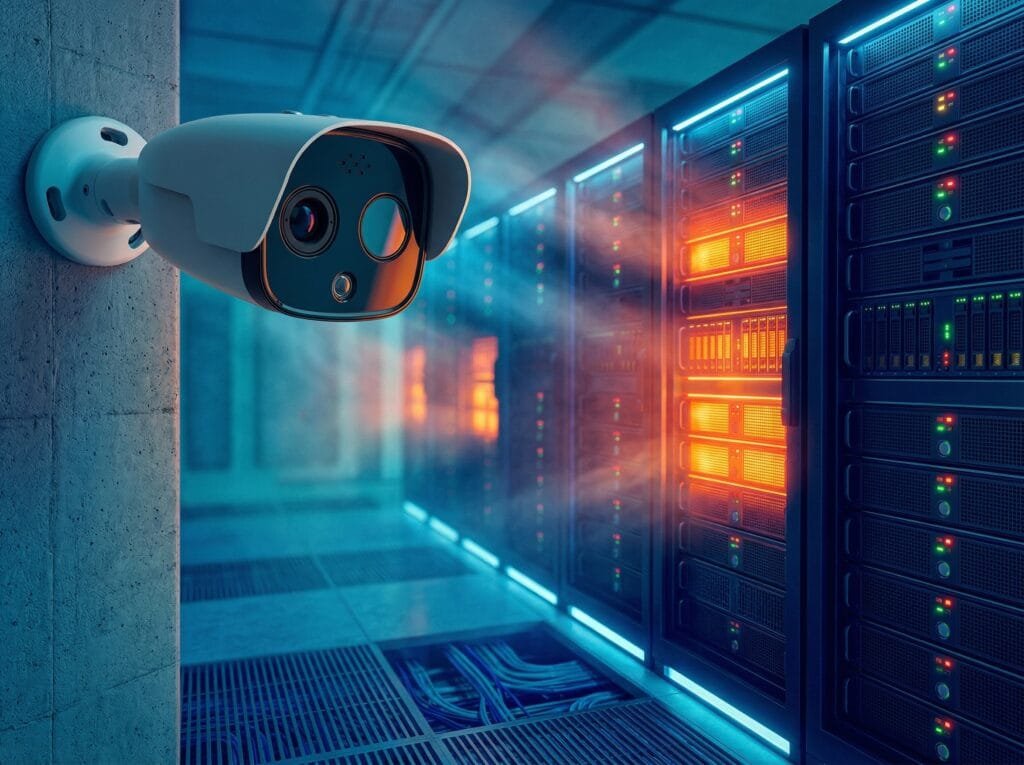
Your Data Center Is Running Hot. Are You Actually Watching?
Be honest. What does “monitoring your data center” actually mean for your team? For most facilities, it’s a wall of CCTV screens, a few spot sensors in the CRAC units, and a hope that whoever’s on call catches it before it turns into a 3 AM incident bridge.
Here’s the thing: a standard camera is a historian. It records what happened. A thermal camera is more like a doctor — it reads vital signs continuously, spots the fever before the patient collapses, and alerts you while there’s still time to do something about it.
In 2026, with GPU rack densities hitting 40–80 kW and lithium-ion batteries in every Tier III facility, the cost of a thermal blind spot has never been higher. Let’s fix that.
25%+
of unplanned outages caused by undetected thermal buildup
48–72h
average thermal warning window before a critical electrical failure
$9K
average cost of data center downtime per minute (Uptime Institute)
15–30%
cooling energy savings achievable through thermal-guided PUE optimization
The Threat You Can't See on a Normal Camera
Standard CCTV captures light. A failing capacitor doesn’t glow. An overloaded PDU branch doesn’t wave a flag. A cooling failure in progress is completely invisible to every camera in your current setup — right up until the point it isn’t, and by then the damage is done.
Thermal cameras work on infrared radiation — the heat every object emits. A degrading bus bar connection starts getting warm days before it becomes a fault. A UPS battery cell heading toward failure shows a distinct thermal signature long before its voltage reading drops. These are the warnings your current setup is missing entirely.
Why Infrared Thermography Changes the Game for Server Rooms
Infrared thermography in server rooms utilizes thermal cameras to create real-time heat maps by detecting infrared radiation emitted by objects above absolute zero. This technology can identify issues like overheating circuit breakers or failing UPS battery cells by recognizing their unique thermal signatures before problems become critical.
Modern fixed thermal cameras deployed in data center corridors and above electrical panels deliver up to 640×512 thermal resolution with temperature measurement accuracy to ±2°C, covering a range of −20°C to +550°C. That’s the difference between knowing a component is getting warm and knowing precisely how warm it is, where, and for how long.
Facility Manager Reality Check: A single unplanned outage at a hyperscale facility can cost between $500K and $5M in direct losses, SLA penalties, and emergency recovery. A comprehensive thermal surveillance system for the same facility costs a fraction of that — and pays for itself the first time it catches a failing switchgear connection before it arcs.
Types Of Fixed Therma Camera
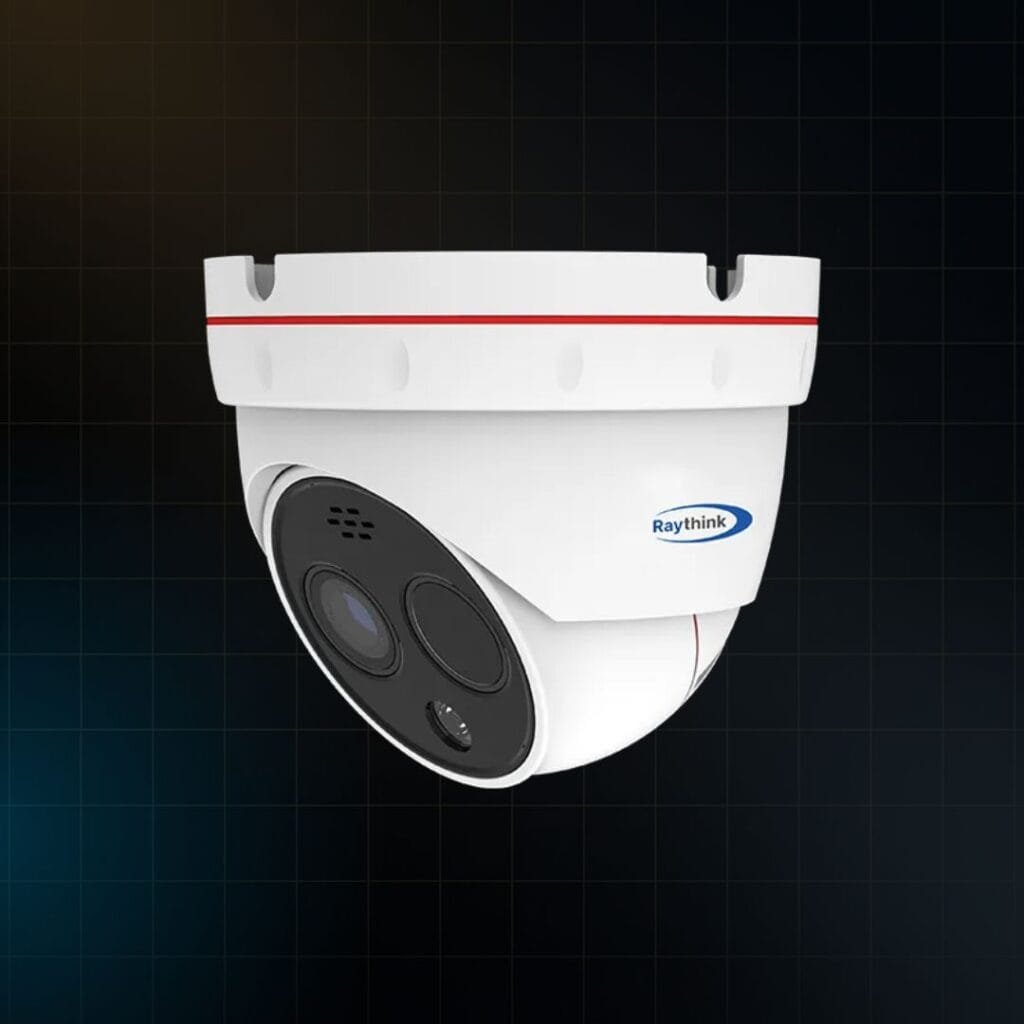
Dual-Spectrum Turret Thermal Camera
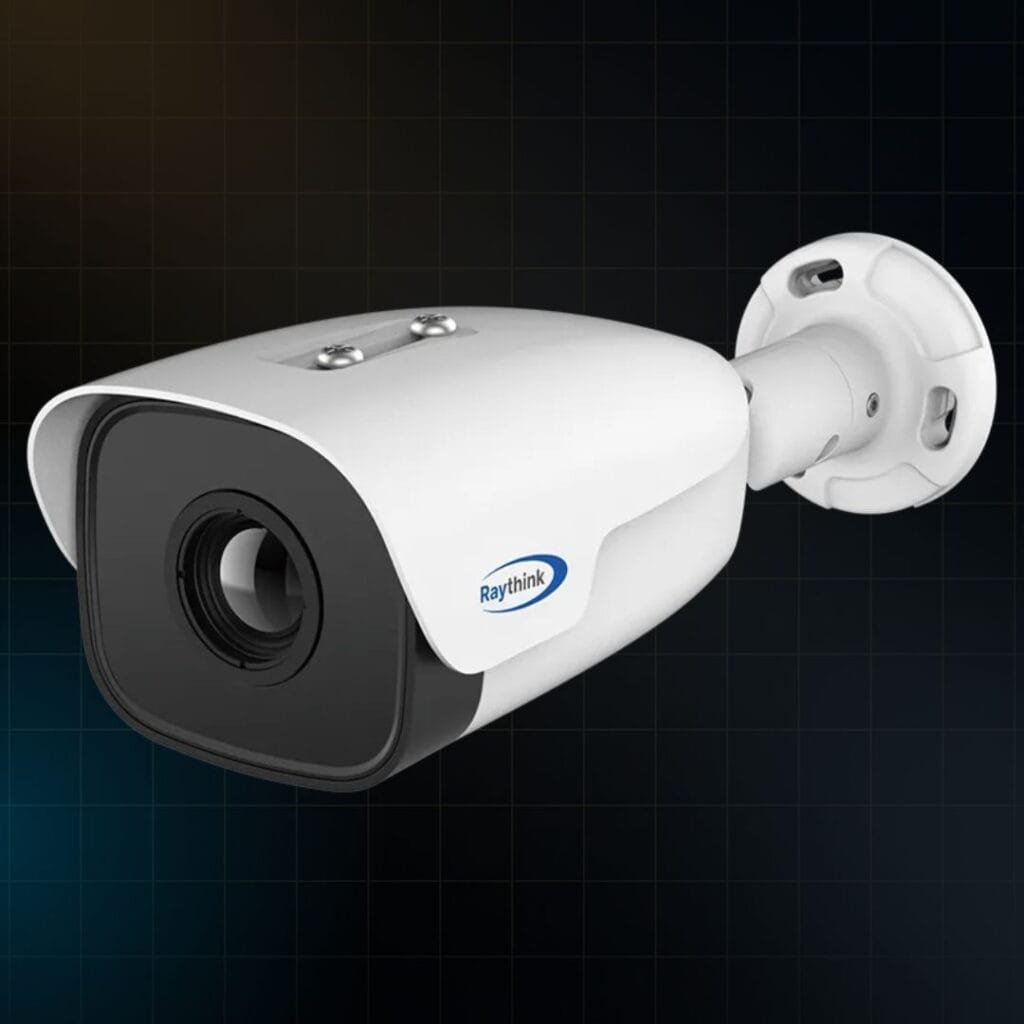
Thermal Bullet Thermal Camera
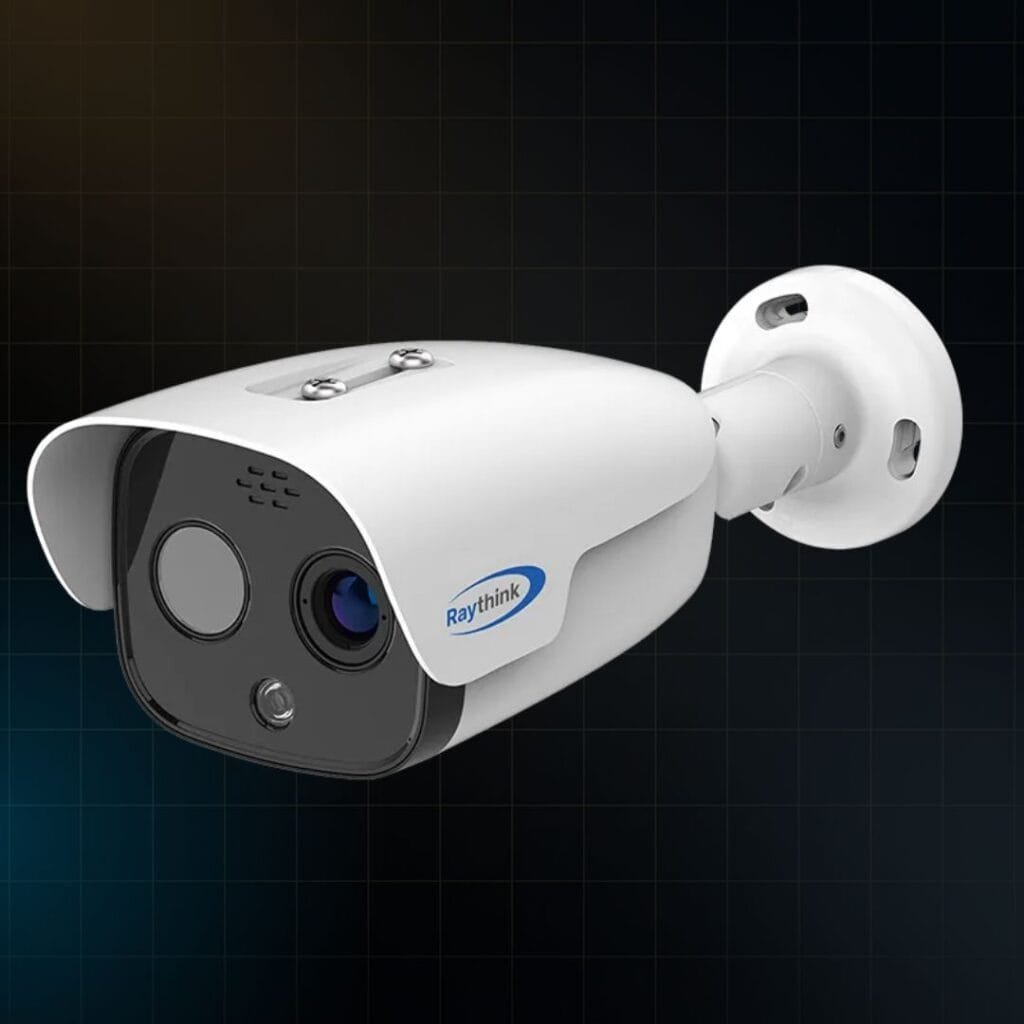
Dual-Spectrum Bullet Thermal Camera
Electrical Switchgear Thermal Inspection: The High-Stakes Use Case
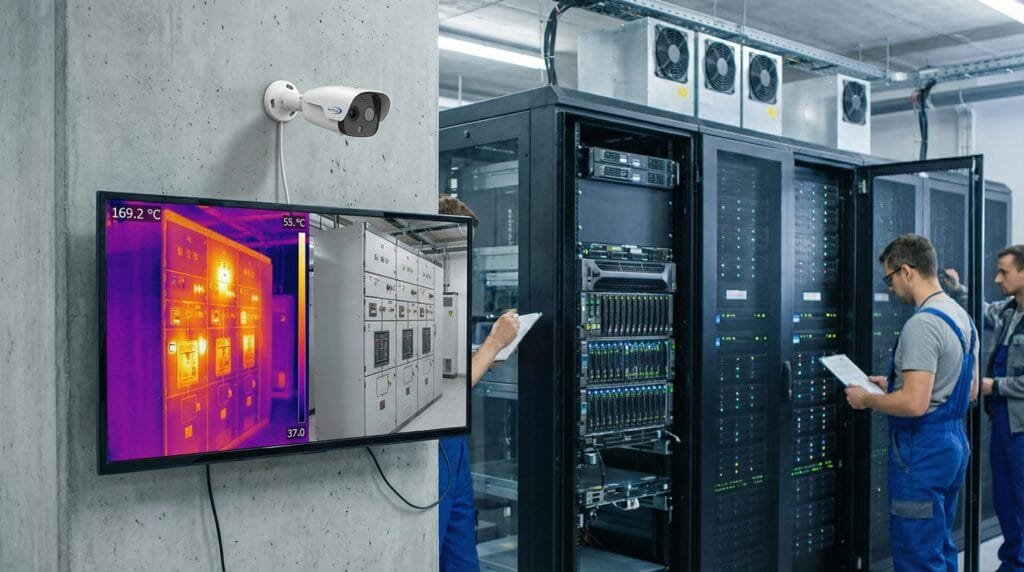
Of all the applications in a data center, electrical switchgear thermal inspection is where thermal imaging delivers its most immediate and dramatic value. Main distribution boards, transfer switches, and bus bars are the cardiovascular system of your facility. When a connection degrades — through oxidation, mechanical stress, or load imbalance — resistance increases and heat builds. That heat is detectable weeks before failure.
- Loose or corroded bus bar connections show localized hot spots distinguishable from healthy connections within seconds of a thermal scan
- Three-phase load imbalance appears as asymmetrical heat patterns across breaker rows — a clear indicator before current thresholds are breached
- Failing power factor correction capacitors exhibit elevated thermal signatures that differentiate them from healthy units in the same bank
- Cable termination faults in MV/LV switchgear are among the leading causes of arc flash events — all detectable thermally while power remains on
Thermal Monitoring for UPS and PDU Health
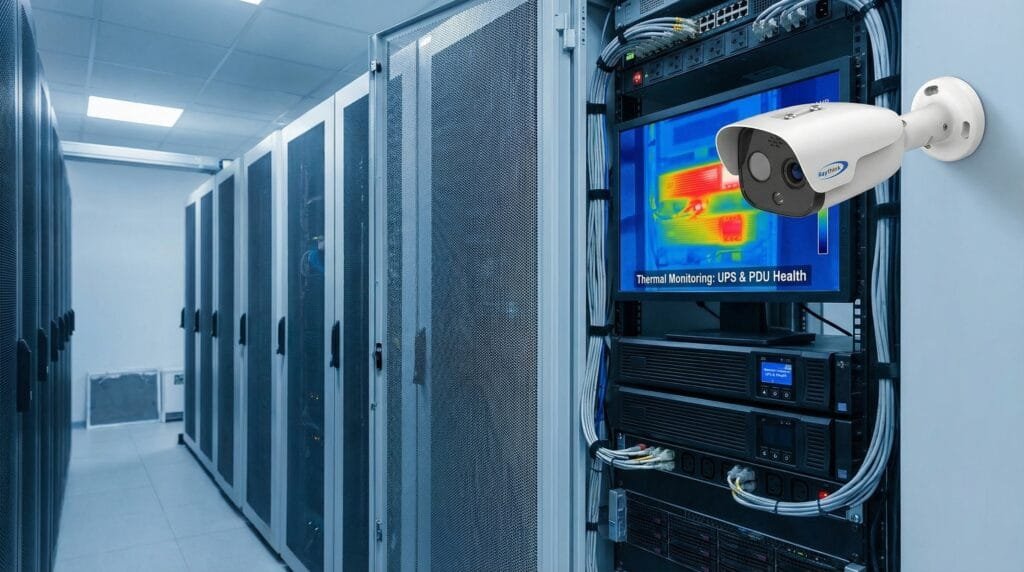
To reduce the risk of unplanned downtime occurring at hyperscale data centers, it has become critical to monitor the entire power chain on a continuous basis. One of the biggest opportunities for unmonitored links in this chain relates to the health of the UPS and the PDU. For example, as the battery cells degrade within a UPS system, differential thermal signatures can be observed across its battery strings, signalling battery cell failure. In addition, an overloaded outlet branch in a PDU could display elevated temperatures at the branch circuit breaker and cabling significantly before an alarm is issued for exceeding the current rating.
Positioning fixed thermal cameras to continuously view UPS battery rooms and PDU cabinets, along with the integration of a thermal analytics platform, allows for automated alerts to be generated the instant the temperatures exceed user-specified thresholds — without the need for any human intervention to initiate the response.
Early Fire Detection for Lithium-Ion Battery Rooms
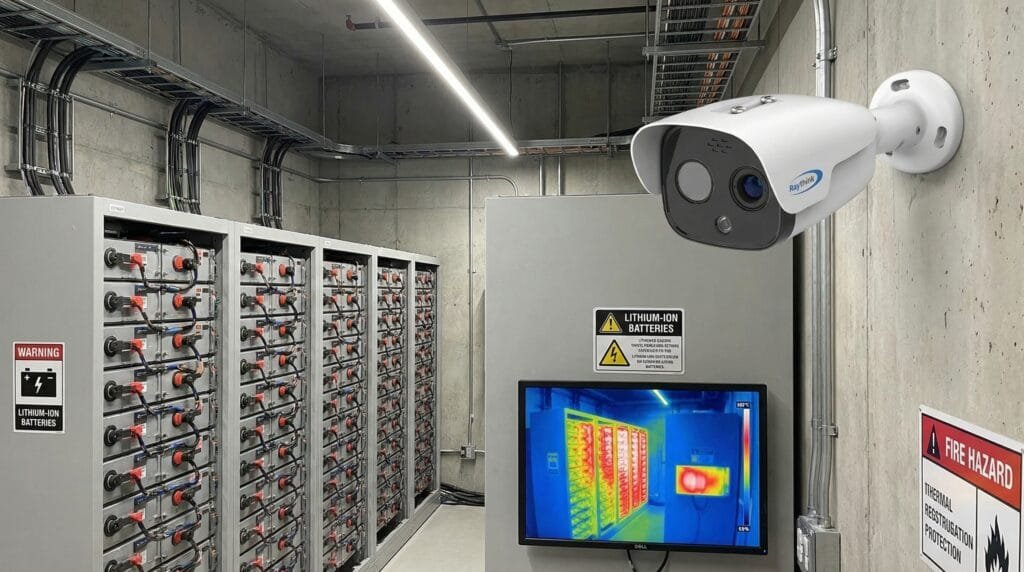
This is the use case that has moved from “advanced capability” to “essential requirement” faster than almost anything else in data center safety in the past two years. As lithium-ion batteries replace VRLA batteries in UPS and energy storage systems, early fire detection for lithium-ion battery rooms has become a critical challenge. Lithium-ion thermal runaway is notoriously difficult to detect with conventional smoke or gas sensors until it is well advanced — often too late for safe suppression.
Thermal imaging provides the earliest possible warning: a cell entering pre-runaway thermal excursion produces a heat signature 10–20 minutes before venting begins. A fixed thermal camera with threshold alerting configured to the battery manufacturer’s temperature specifications is now considered best practice in any facility carrying lithium-ion energy storage above a nominal capacity threshold.
"In mission-critical environments, the cost of prevention is always less than the cost of failure. Thermal surveillance is not a luxury — it is a fundamental requirement."
Thermal Sensors for High-Density AI Infrastructure: What to Specify
When specifying thermal sensors for high-density AI infrastructure, these are the parameters that matter most in practice:
Thermal Resolution
640×512 for dense areas; 320×256 for lower-density monitoring.
Temperature Accuracy
±2°C for maintenance; ±1°C or better for precise PUE use.
Frame Rate
25–30 Hz is enough for static monitoring; more for moving machinery.
Lens Focal Length
3.2–7.5mm room view; 9–19mm rack detail; 25–55mm precision inspection.
Integration
ONVIF, API, or MQTT for VMS, DCIM, and ITSM integration.
Operating Environment
Use suitable IP rating; IP66+ may be needed in battery or cooling areas.
Thermal vs. Conventional Monitoring: An Honest Comparison
| Capability | CCTV / Visible Camera | Point Temp Sensors | Thermal Camera |
|---|---|---|---|
| Detects failing electrical connections | No | Partial | Yes |
| Works in complete darkness | No | Yes | Yes |
| Spatial hotspot mapping | No | No | Yes |
| Li-ion pre-runway detection | No | Limited | Yes |
| CRAC setpoint optimization data | No | Partial | Yes |
| Containment leak verification | No | No | Yes |
| Continuous automated alerting | No | Yes | Yes |
| ISO 50001 / ESG audit evidence | No | Partial | Yes |
5 Steps to Deploy Thermal Monitoring in Your Facility
The most common barrier to thermal monitoring implementation isn’t cost — it’s uncertainty about where to start and how to integrate thermal data with existing DCIM, BMS, and ticketing systems. This framework is designed to be executable by a facility team without specialist thermography expertise at every step.
Map your thermal risk zones
Rank your facility by risk: electrical switchgear and UPS rooms first, battery rooms and generators second, CRAC and cooling infrastructure third, IT floor hot/cold aisles for continuous monitoring. This drives your camera spec and placement decisions.
Capture a thermal baseline
Run a 24–72 hour baseline under representative load. This is your reference for anomaly detection and your ISO 50001 energy performance starting point. Document it properly — you'll reference it for every future audit.
Install cameras and configure alerts
Start with your highest-risk zones. Set temperature thresholds based on equipment manufacturer specs and ASHRAE guidelines — not arbitrary round numbers. Connect to your VMS or DCIM platform and define your escalation path clearly.
Connect to your ticketing system
A thermal alert that doesn't create a ticket gets missed. Build the integration from day one: threshold breach → automatic incident ticket → on-call notification → thermal image attached. No email threads, no guesswork.
Run quarterly audits and review PUE impact
Thermal monitoring isn't set-and-forget. Quarterly walkthroughs catch what fixed cameras miss. Combine audit findings with energy meter data for a quarterly PUE report — useful internally and for ESG disclosures.
Conclusion
Heat doesn’t announce itself. It builds quietly — inside a bus bar connection, across a battery string, behind a misaligned blanking panel — until it can’t be ignored anymore. By that point, you’re not managing infrastructure. You’re managing an incident.
Thermal imaging doesn’t promise to make your data center perfect. What it does is close the biggest gap in most facilities’ monitoring stack: the ability to see what’s going wrong before it actually goes wrong. That’s not a small thing. In a world where $9,000 per minute of downtime is the average, it’s everything.
The technology is mature. The integration paths are well-defined. The ROI is measurable in the first quarter. The only question is whether you deploy it before your next incident or after it.
Pantronics India is the authorised distributor of Raythink in India — giving you direct access to enterprise-grade thermal surveillance hardware, local technical support, and the kind of post-sales accountability that matters when you’re protecting mission-critical infrastructure.
Frequently Asked Questions
Typically 48–72 hours for critical faults, and often much longer for gradual connection degradation — sometimes days or even weeks. A deteriorating bus bar connection usually shows measurable thermal deviation well before it reaches failure temperature. In every case, the thermal warning comes before any voltage or current reading drops to an alarming level.
They complement each other rather than replace each other. Thermal cameras are excellent at detecting active leaks (via the cold evaporating-coolant signature) and catching capacity loss early (via rising GPU temperatures). Dedicated rope-style leak sensors catch small-volume pooling that builds before a thermal signature develops. For mission-critical AI infrastructure, use both.
Depends on the application. For wide-area aisle monitoring, 320×256 is fine at typical mounting heights. For electrical panel inspection and component-level fault detection — where you need to distinguish between adjacent breakers or battery cells — 640×512 is the practical minimum. If budget is a constraint, start with lower resolution for broad coverage and supplement with higher resolution or periodic handheld inspections for high-priority electrical equipment.
Facilities implementing thermal-guided cooling optimization typically see 0.05–0.15 PUE reduction, depending on starting point and how much overcooling and containment bypass exists. Facilities above 1.6 PUE usually see the largest gains. A single thermal audit with targeted containment remediation commonly delivers 8–12% reduction in cooling energy within 90 days.

Expert Technical Support
Looking to deploy Raythink thermal cameras in your Indian data center? Whether you’re starting with a single switchgear inspection camera or rolling out facility-wide coverage across a hyperscale campus, we can help you specify the right system, get it deployed, and keep it running.
Mr. Praveen Upadhaya (Specialized in Thermal camera)
Mail ID: p.upadhyaya@pantronicsindia.com