

IGBT Thermal Interface: Reducing Junction Temperature in Solar Inverters
A practical engineering guide for Indian solar inverter designers — how the right Shin-Etsu thermal interface material (TIM) cuts IGBT junction temperature (Tj), extends MTBF and improves CEC efficiency in 1500 V string and central inverters.
Why IGBT junction temperature decides inverter lifetime
In a solar inverter, the IGBT module is the single largest heat source. Switching losses and conduction losses dump 0.8–2 % of rated power as heat — for a 100 kW string inverter that is roughly 1.5 kW continuously dissipated through a heatsink the size of a shoebox. Every additional 10 °C in IGBT junction temperature (Tj) roughly halves the module’s bond-wire fatigue life(Coffin-Manson / LESIT data).
Most IGBTs are rated for Tj(max) = 150–175 °C, but field MTBF targets of 25 years for solar plants force designers to keep Tj well under 125 °C even at 50 °C ambient — common in Rajasthan, Gujarat, Andhra Pradesh and Tamil Nadu solar parks. The thermal interface material between the IGBT base plate and the heatsink is the single biggest variable a designer can still tune late in the project.
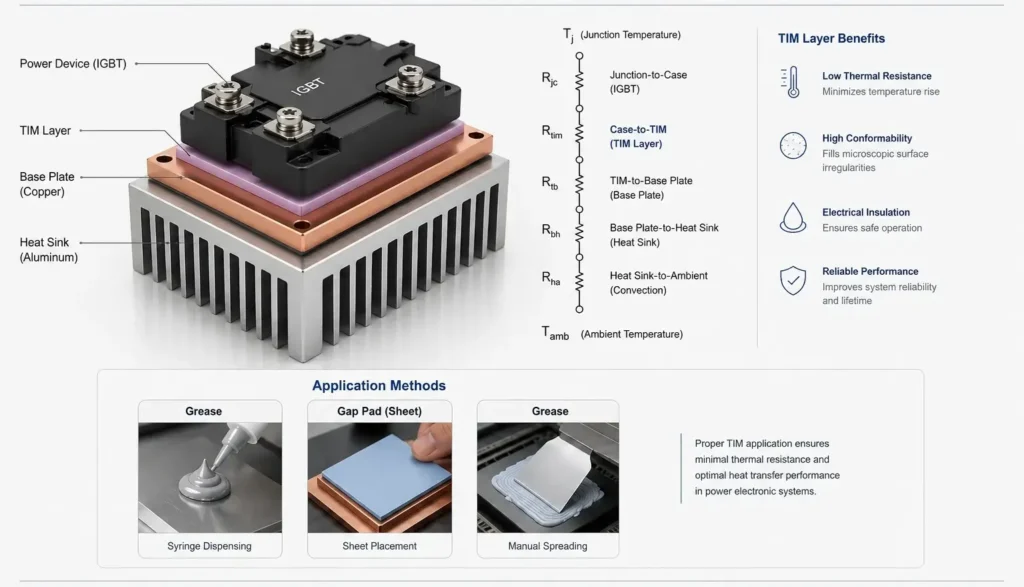
A 0.2 °C·cm²/W reduction in interface thermal resistance can drop Tj by 8–12 °C — roughly doubling IGBT power-cycling lifetime.”
The IGBT thermal stack — where TIM lives
Heat flows from silicon die → solder → DBC ceramic → base plate → thermal interface material → heatsink → ambient air. Of the entire chain, the TIM layer is typically 40–60 µm thick yet contributes 20–35 % of the total junction-to-ambient thermal resistance in a well-designed inverter. Air gaps as small as 5 µm — invisible to the eye — can spike Rth by 30 %.
Two mechanical realities make TIM selection difficult: IGBT base plates have 50–100 µm of bow after soldering, and they undergo ±60 °C thermal cycling daily. The TIM must fill that bow on day 1 and stay in place for 25 years without pump-out, dry-out or migration.
Shin-Etsu offers four families that cover virtually every IGBT cooling scenario in renewable-energy power conversion. Here is how they compare for a typical 1500 V string inverter:
| TIM Type | Shin-Etsu Series | Conductivity | Best For |
|---|---|---|---|
| Silicone Grease | G-7xx, X-23 Series | 2.5 – 6.5 W/m·K | Discrete IGBTs, TO-247, low BLT |
| Thermal Gap Pad | TC-UP / TC-100 Series (up to 8 W/m·K) | 3 – 8 W/m·K | Module to heatsink, high reliability |
| Phase Change Material | PCS Series | 3 – 5 W/m·K | Pump-out resistant, long-life IGBT modules |
| Liquid Gap Filler | SDP / CLG Series | 2 – 6 W/m·K | Automated dispensing, large area gaps |
Recommended Shin-Etsu grades for IGBT cooling
TC-UP8 — High-Conductivity Gap Pad (8 W/m·K)
The workhorse for solar string inverters. Soft (Shore 00 ~40), 0.5–3.0 mm thickness, 5 kV/mm dielectric strength. Compresses 20–40 % to fill IGBT base-plate bow without overstressing solder joints. Used by tier-1 Indian inverter brands for SiC and IGBT modules from Infineon, Semikron and Mitsubishi.
PCS-PSS-100 — Phase Change Sheet
Solid at room temperature for clean handling, melts at ~50 °C to flow into every micro-asperity. Achieves thermal resistance below 0.05 °C·cm²/W — comparable to grease — but with zero pump-out over thousands of power cycles. Ideal for central inverters and EV fast chargers.
G-775 / X-23-7921-5 — Premium Silicone Grease
6.5 W/m·K silicone grease for TO-247 / TO-264 discrete IGBTs in micro-inverters and MPPT boost stages. Stable from −45 °C to +200 °C, low oil bleed (<1 %), long shelf life — important for Indian distributors and EMS factories.
Case study: 100 kW string inverter, Rajasthan
An Indian solar inverter OEM was seeing field failures of IGBT half-bridge modules after 18 months in 100 MW ground-mount plants near Jodhpur. Ambient peaks of 48 °C combined with a generic 3 W/m·K silicone pad were pushing Tj above 135 °C during summer afternoons.
Pantronics application engineering re-qualified the design with Shin-Etsu TC-UP8 (8 W/m·K) at 0.5 mm BLT. Measured results on the same heatsink, same airflow:
- Case-to-sink Rthdropped from 0.34 to 0.18 °C·cm²/W
- Peak Tjreduced from 135 °C to 116 °C
- Predicted IGBT power-cycling lifetime increased ~3.5×
- CEC weighted efficiency improved by 0.3 % due to reduced VCE(sat)drift
Selection checklist for design engineers
- Target Tj < 125°C at 50°C ambient — calculate your full Rth budget first
- Bond-line thickness: 50–200 µm for grease, 0.5–3 mm for gap pads
- Dielectric strength ≥ 4 kV/mm for 1500 V DC bus
- UL 94 V-0 flammability for inverter enclosure compliance
- RoHS / REACH compliant — required for EU export from India
- Operating range −40°C to +150°C minimum for Indian field conditions
- Low siloxane / low outgassing for sealed enclosures with PCBs
- Verified pump-out resistance over 10,000 power cycles
Conclusion
Reducing IGBT junction temperature is the highest-leverage reliability decision a solar inverter designer can make. Moving from a generic 3 W/m·K thermal pad to a qualified Shin-Etsu high-conductivity gap pad, phase change material or liquid gap filler can drop Tj by 10–20 °C, multiply IGBT lifetime by 3–4×, and improve weighted efficiency — all without redesigning the heatsink, magnetics or enclosure. For Indian solar inverters, EV chargers and industrial drives where ambient temperatures regularly cross 45 °C, the right TIM is no longer a commodity choice; it is a core reliability component.
Pantronics India — Authorised Distributor of Shin-Etsu Thermal Interface Material solutions — thermal gap pads, silicone soft pads, phase change materials (PCM), liquid gap fillers, thermal silicone adhesives and potting & encapsulant materials — supported by application engineering, sample stock and India-wide logistics.
Frequently Asked Questions (FAQ)
SiC modules switch faster and run hotter (Tj up to 175 °C). We recommend Shin-Etsu TC-UP8 gap pad or PCS phase change sheet for the lowest thermal resistance combined with high dielectric strength.
Follow the IGBT vendor’s torque spec (typically 3–5 Nm for M5). The Shin-Etsu pad will compress 20–40 % — verify final BLT with a feeler gauge or shim during qualification.
Yes. The Shin-Etsu SDP and CLG liquid gap filler series are two-part dispensable materials qualified for robotic dispensing on SMT lines — used by leading EMS providers in Pune, Bengaluru and Chennai.
Pantronics India is the authorised distributor of Shin-Etsu thermal interface materials in India, stocking gap pads, PCM, liquid gap fillers, silicone grease and potting compounds with technical support from our application engineering team.

Need thermal interface material assistance?
Get expert guidance on Shin-Etsu thermal gap pads, phase change materials, and silicone grease — from grade selection and bond-line thickness to dispensing trials and long-term reliability qualification for solar inverters, EV chargers, and industrial drives.
Mail ID: pooja@pantronicsindia.com