
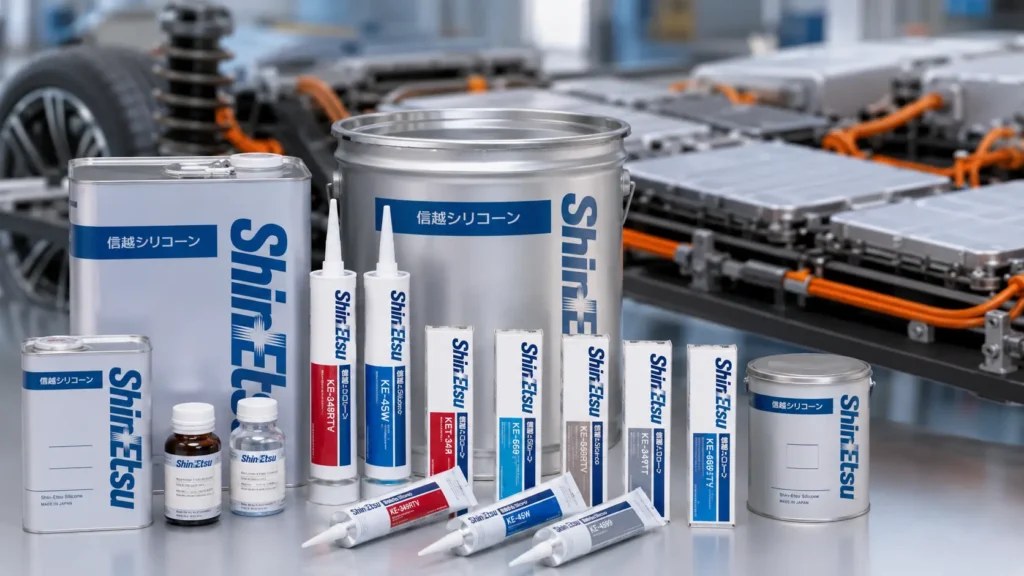
Battery Enclosure Sealing, Thermal Interface Materials & Thermal Runaway Protection for EVs
EV thermal management silicone sealants play a critical role in protecting electric vehicle batteries and electronics from heat, moisture, and mechanical stress.
Electric vehicles are transforming mobility, but their long-term reliability depends on more than advanced battery chemistry. Effective EV thermal management, battery enclosure protection, and electronics reliability all rely on materials that most people never see. Among the most important of these materials are silicone sealants. They help prevent moisture ingress, improve heat transfer, protect sensitive electronics, and support battery safety throughout the vehicle lifecycle.
Yet many EV failures can be traced back not to the battery cells themselves, but to the systems designed to protect them. Moisture intrusion, thermal hot spots, electronic failures, and thermal propagation events often begin with material performance issues that were overlooked during design or procurement.
This article explores the key thermal management challenges facing EV manufacturers and how Shin-Etsu silicone sealants help improve battery reliability, safety, and long-term performance.
EV Thermal Management Challenges in Modern Electric Vehicles
Modern EV battery packs operate in demanding environments.
Every charge cycle generates heat. Every discharge cycle creates thermal stress. Add vibration, road shock, humidity, dust, and extreme temperatures, and manufacturers face a significant engineering challenge.
Effective EV thermal management is essential because excessive heat can:
- Reduce battery lifespan
- Lower charging efficiency
- Accelerate cell degradation
- Damage power electronics
- Increase safety risks
While cooling systems and battery management software receive significant attention, the materials that seal, insulate, and protect these systems are equally important.
This is where high-performance silicone technologies become critical.
How Silicone Sealants Prevent EV Battery Enclosure Failures
Battery enclosures are designed to protect cells from water, dust, and environmental contamination. Most EV battery packs successfully pass IP67 testing during production, but real-world conditions are far more demanding.
The challenge comes from continuous thermal cycling.
As batteries charge and discharge, aluminium enclosures repeatedly expand and contract. Over thousands of cycles, this movement creates stress at the bond line between the enclosure and the sealant.
Many conventional materials gradually lose adhesion under these conditions.
The seal itself may appear intact, yet microscopic gaps begin forming at the interface. Eventually, moisture enters the enclosure and starts damaging sensitive battery components.
This type of failure is often discovered only after significant degradation has already occurred. Automotive-grade silicone sealants are specifically designed to withstand long-term thermal cycling while maintaining flexibility and adhesion.
Shin-Etsu silicone sealants provide:
- Long-term adhesion to aluminium and engineering plastics
- Resistance to thermal cycling
- Excellent weatherability
- Moisture protection
- High-temperature stability
For EV manufacturers targeting long battery life and reduced warranty claims, reliable battery enclosure sealing is no longer optional, it is a design requirement.
Thermal Interface Materials for Better EV Battery Cooling
One of the biggest challenges in EV thermal management is transferring heat away from battery cells efficiently.
Even a tiny air gap between a battery module and its cooling plate can significantly reduce thermal conductivity.
A gap measuring only fractions of a millimetre may increase operating temperatures enough to accelerate cell aging and reduce overall battery performance.
These temperature differences create:
- Uneven cell degradation
- Reduced battery efficiency
- Lower charging performance
- Increased thermal stress
This is why thermal interface materials (TIMs) play such an important role in modern battery pack design.
Silicone-based thermal interface materials conform to irregular surfaces and eliminate air gaps that interfere with heat transfer.
Unlike rigid solutions that may lose contact under vibration or manufacturing tolerances, silicone materials maintain consistent thermal pathways throughout the life of the vehicle.
Shin-Etsu thermal interface materials combine:
- Thermal conductivity
- Gap-filling capability
- Vibration resistance
- Electrical insulation
- Long-term durability
The result is more effective battery cooling, improved thermal uniformity, and greater reliability under demanding operating conditions.
Protecting EV Power Electronics with Automotive Silicone Sealants
Battery packs are not the only systems exposed to harsh operating conditions.
Power electronics—including inverters, DC-DC converters, onboard chargers, and control modules—must perform reliably despite constant exposure to environmental and thermal stress.
In Indian operating conditions, these systems face:
- High humidity
- Monsoon exposure
- Fine dust contamination
- Continuous vibration
- Large temperature fluctuations
Traditional coatings often struggle to maintain long-term protection in these environments.
Over time, thermal expansion and contraction can cause cracking, delamination, and moisture penetration.
Once contamination reaches sensitive circuitry, corrosion and electrical failures can follow.
Automotive silicone sealants offer a more robust solution by providing flexible protection that remains stable under thermal and mechanical stress.
Key benefits include:
- Excellent dielectric properties
- Low ionic contamination
- Strong adhesion to multiple substrates
- Moisture resistance
- Resistance to thermal fatigue
Shin-Etsu’s electronics-grade silicone technologies are trusted globally because they provide reliable protection for critical electronic systems operating in demanding environments.
Silicone Sealants for Thermal Runaway Protection in EV Batteries
Thermal runaway remains one of the most serious safety concerns in electric vehicle design.
When a battery cell enters thermal runaway, heat rapidly spreads through adjacent cells. Once the process begins, stopping it becomes extremely difficult.
The focus therefore shifts to containment and propagation control.
Manufacturers must design battery packs that slow the spread of heat long enough for safety systems to respond and occupants to exit safely.
Flame-retardant silicone sealants help achieve this objective.
Unlike many organic materials that contribute fuel during a fire event, silicone-based materials typically char rather than burn. This behaviour can help slow thermal propagation between battery modules and improve overall pack safety.
As safety regulations continue evolving—including AIS-156 requirements in India—material selection is becoming increasingly important during battery development.
For many manufacturers, thermal runaway protection is no longer a competitive advantage; it is becoming a compliance necessity.
Shin-Etsu Chemical is recognized globally as the world’s largest silicone manufacturer and a trusted supplier to automotive, electronics, semiconductor, and industrial markets.
Its reputation is built on decades of material science expertise and proven field performance.
For EV applications, Shin-Etsu silicone sealants are valued for their combination of:
- High-temperature resistance
- Long-term flexibility
- Superior adhesion
- Low outgassing
- UV and ozone stability
- Electrical insulation performance
- Environmental durability
These characteristics make them suitable for battery enclosure sealing, thermal management systems, power electronics protection, and thermal runaway mitigation.
However, material performance depends on authenticity. Counterfeit and grey-market products remain a concern in the Indian market. While they may appear similar on paper, their long-term reliability often differs significantly from genuine materials.
Working with an authorized distributor ensures full traceability, verified quality, technical support, and confidence in product performance.
As EV technology continues to evolve, manufacturers face increasing pressure to improve reliability, safety, and performance while meeting demanding regulatory requirements.
From battery enclosure sealing and thermal interface materials to power electronics protection and thermal runaway mitigation, silicone sealants play a critical role in modern EV design.
The right material selection can help:
- Improve EV thermal management
- Reduce moisture-related failures
- Enhance battery reliability
- Protect sensitive electronics
- Support regulatory compliance
- Extend product service life
Shin-Etsu’s automotive-grade silicone technologies are engineered to meet these challenges, providing the performance required for next-generation electric vehicles.
As India’s authorized Shin-Etsu Silicone distributor, Pantronics India offers genuine materials, application engineering support, technical expertise, and reliable supply chain access for EV manufacturers, battery pack integrators, and electronics companies across India.
When EV reliability depends on getting the details right, the sealant matters just as much as the battery itself.
Frequently Asked Questions (FAQ)
Silicone sealants provide flexibility, heat resistance, moisture protection, and vibration durability, making them ideal for battery enclosure sealing and thermal protection applications.
EV thermal management refers to the systems and materials used to control temperatures within batteries, motors, and power electronics to improve safety, efficiency, and reliability.
Thermal interface materials eliminate air gaps between battery components and cooling systems, improving heat transfer and maintaining more uniform operating temperatures.
Yes. Sealant performance influences moisture protection, insulation resistance, durability, and thermal propagation behaviour, all of which affect battery reliability and safety.

How Silicone Sealants Improve EV Thermal Management and Battery Protection
Learn how Shin-Etsu silicone sealants protect EV battery enclosures, improve thermal interface performance, and prevent thermal runaway. Pantronics India is your authorized Shin-Etsu silicone distributor, offering genuine materials and technical support for EV manufacturers and battery pack integrators.
Ms. Pooja (Silicone Materials Specialis)
Mail ID: pooja@pantronicsindia.com