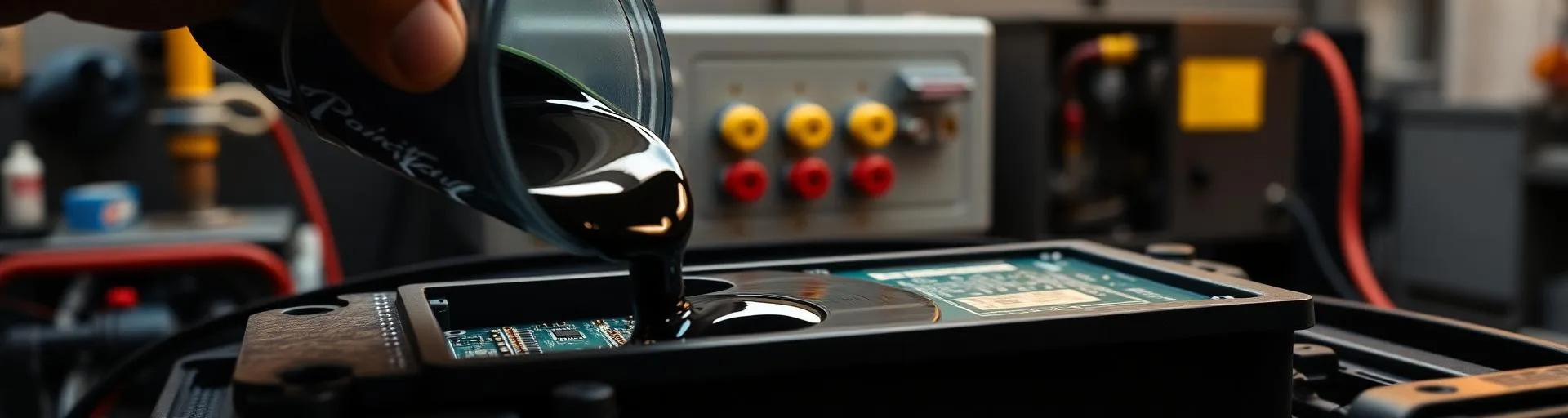
Two-Component Silicone Potting Compounds
The authorised silicone thermal pad India source — Shin-Etsu TC-CA, TC-SP, TC-PEN and TC-UP8 series. Ultra-conformable pads that follow uneven, stepped or multi-component heat sources, from 1.5 to 8.0 W/m·K, Asker C 2–40 hardness and 0.5–10 mm thickness for EV battery packs, power modules and consumer electronics.
2.1–3.2
W/m·K
2-component
Thickness
V-0
Asker A 15–53
Overview
What Are KE Series Potting Compounds?
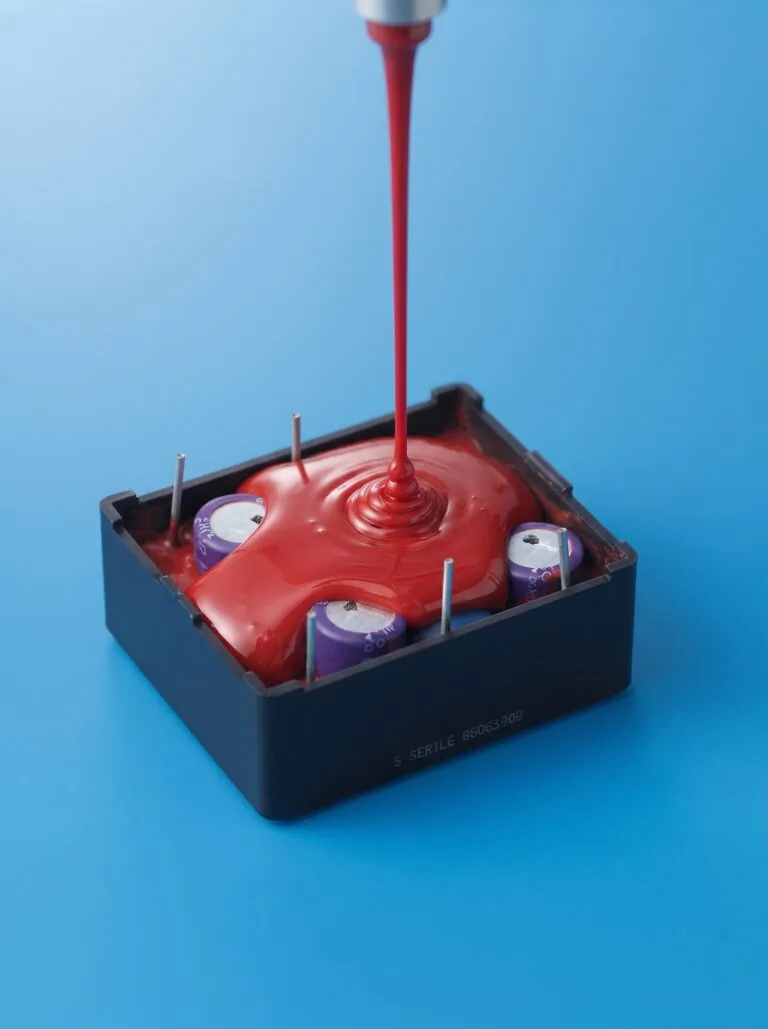
KE Series potting compounds are two-component, addition-cure silicone elastomers formulated with thermally conductive fillers. Mixed A+B at 1:1 ratio and poured around an electronic assembly, they self-level to fill all voids before curing to a soft, flexible rubber that simultaneously:
Conducts heat to the housing · Insulates electrically · Seals against moisture and contamination · Damps vibration and mechanical shock
Four grades span from ultra-soft (KE-1897S-A/B, Asker A 15) for maximum stress relief to firm (KE-8001-A/B, Asker A 53) for structural applications. KE-8006-A/B is the room-temperature cure grade for assemblies that cannot be subjected to oven heat; the other three grades cure at 120°C × 1 h.
- Two-component addition cure — no byproduct gas, predictable pot life and cure profile
- Soft cured hardness (Asker A 15–53) for low mechanical stress on encapsulated components
- Provides thermal management, electrical insulation, moisture sealing and vibration damping simultaneously
- KE-8006-A/B: 23°C × 24 h room-temperature cure — no oven required
- KE-8001-A/B: 3.2 W/m·K — highest conductivity in the potting range
- Long pot life (2–48 h depending on grade) for complex pours and vacuum degassing
Application Scenes
Where Silicone Soft Pads Are Used
Soft pads span consumer electronics, industrial power, EV batteries and server infrastructure — anywhere surfaces are uneven or tolerance stack-up prevents sheets from maintaining consistent contact.
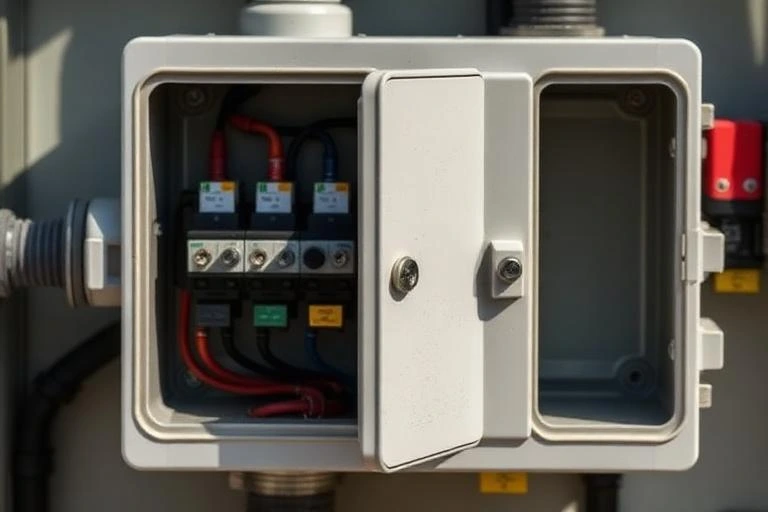
Outdoor Terminal Box Encapsulation
KE-1899-A/B (3.0 W/m·K) is poured into outdoor terminal connection boxes, simultaneously sealing against rain and condensation, electrically insulating the terminals and dissipating heat to the box wall — eliminating the need for separate potting, sealing and thermal management steps.
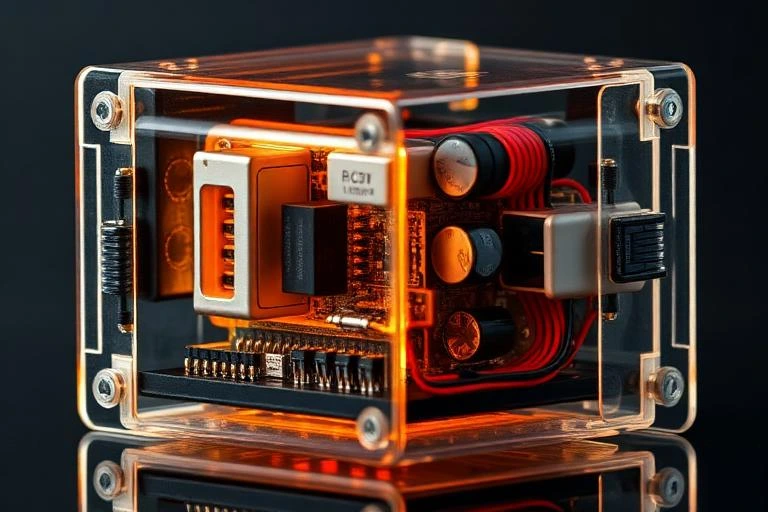
Power Module Moisture Protection
KE-8001-A/B (3.2 W/m·K, Asker A 53) provides the firmest cured hardness in the range for power modules that must resist vibration while the module is potted. The higher hardness prevents the elastomer from flowing under mechanical load while still providing thermal conduction.
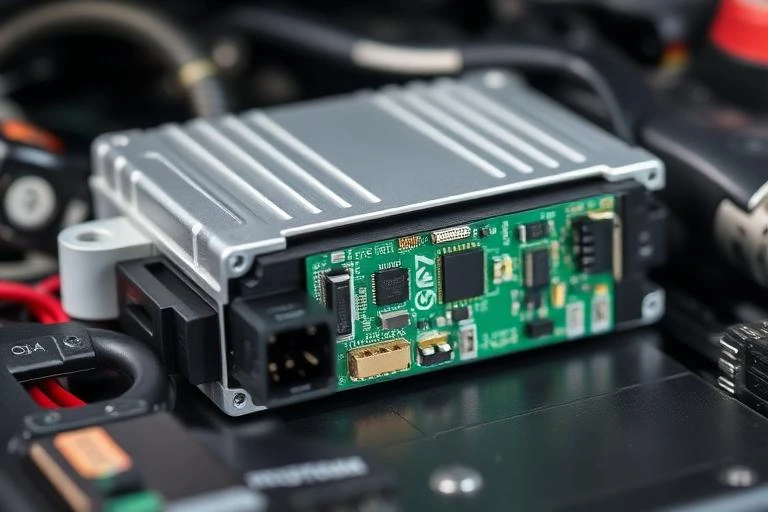
Automotive In-Vehicle Electronics
KE-1897S-A/B (Asker A 15) ultra-soft potting is used in in-vehicle electronics where minimum mechanical stress on sensitive components is required. The very soft elastomer absorbs vibration energy from road and powertrain without transferring it to solder joints or bonding wires.
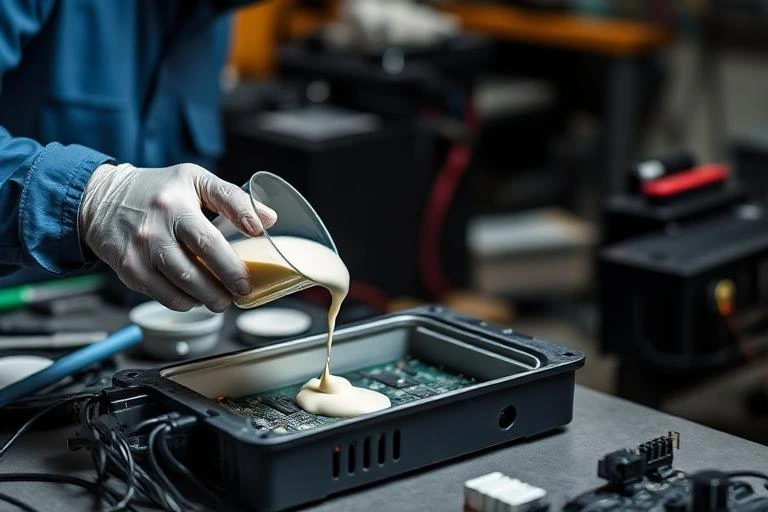
Heat-Sensitive Assemblies — Room Temp Cure
KE-8006-A/B cures at 23°C × 24 h without any oven — the only room-temperature grade in the potting range. Ideal for assemblies with heat-sensitive components such as pre-programmed memory devices, electrolytic capacitors or temperature-calibrated sensors that cannot withstand 120°C oven processing.
Datasheet
General Properties — KE Series Potting Compounds
Properties after cure — JIS R 2616 (thermal), JIS K 6249 (mechanical), JIS K 6850 (lap shear). All: two-component addition cure, A=Gray / B=White appearance.
| Parameter | KE-1897S-A/B | KE-8006-A/B | KE-1899-A/B | KE-8001-A/B |
|---|---|---|---|---|
| Thermal conductivity (W/m·K) | 2.1 | 2.2 | 3.0 | 3.2 |
| Mix ratio A:B (weight) | 100:100 (all grades) | |||
| Pot life at 23°C (h) | 48 | 2 | 48 | 48 |
| Recommended cure | 120°C × 1 h | 23°C × 24 h | 120°C × 1 h | 120°C × 1 h |
| Viscosity at 23°C, A/B (Pa·s) | A:13 / B:7 | A:12 / B:7.5 | A:26 / B:17 | A:33 / B:20 |
| Density after cure (g/cm³) | 2.78 | 2.75 | 2.99 | 3.04 |
| Hardness, Durometer A | 15 | 23 | 16 | 53 |
| Tensile strength (MPa) | 0.3 | 0.4 | 0.3 | 1.0 |
| Elongation at break (%) | 80 | 39 | 60 | 30 |
| Volume resistivity (TΩ·m) | 0.1 | 0.1 | 0.3 | 0.28 |
| Dielectric breakdown (kV/mm) | 17 | 17 | 17 | 19 |
| Lap-shear strength Al/Al (MPa) | 0.2 | 0.3 | 0.2 | 0.5 |
| Flame resistance UL94 | V-0 | V-0 equiv. | V-0 | V-0 |
| LMW siloxane (ppm) | <300 | <300 | <300 | <300 |
Grade Selector
Which Silicone Potting Compound India Grade to Specify
KE potting compound India grades vary in mix ratio, viscosity, working time and cured hardness. Use this guide to match the right grade to your encapsulation process and protection requirements.
| Selection Factor | Low-Viscosity Grade | Medium-Viscosity Grade | High-Viscosity (Thixotropic) |
|---|---|---|---|
| Dispensing method | Gravity pour, low-pressure pot | Pneumatic dispensing gun | Static mixer, meter-mix dispense |
| Complex geometry fill | Excellent — flows into tight spaces | Good | Limited — suitable for open cavities |
| Vertical/overhead applications | Requires dam or mould | Partial self-support | Good sag resistance |
| Cured hardness (Shore A) | 10–25 (soft, flexible) | 20–35 | 25–40 |
| Thermal conductivity (W/m·K) | 1.2–2.5 depending on filler loading and grade | ||
| Operating temperature range | –40°C to +180°C (silicone base) |
Potting vs. conformal coating: A silicone potting compound India fully encapsulates the assembly in a solid elastomer layer — providing mechanical protection, moisture ingress resistance and thermal dissipation simultaneously. Conformal coating only covers the surface. Choose potting when the assembly must withstand water immersion, heavy vibration or corrosive atmosphere.
FAQ
Silicone Potting Compound India — Common Engineer Questions
Silicone potting compound India cures to a flexible elastomer with low Young’s modulus — this absorbs differential thermal expansion stress between the potted board and the housing, preventing solder joint fatigue and component cracking under temperature cycling. Epoxy potting cures rigid, which gives higher structural strength but can crack solder joints or brittle components under thermal shock. For assemblies that will see temperature cycling from –40°C to +125°C or higher, silicone is the safer choice. Epoxy offers better chemical resistance and lower cost for static, stable-temperature applications.
Most KE two-component potting grades use a 1:1 or 10:1 weight ratio (Part A base : Part B catalyst) — confirm the specific grade datasheet as ratios vary. Accurate mixing is essential: off-ratio mixing reduces cured hardness and thermal conductivity and can leave tacky or uncured regions. For production volumes, a meter-mix dispense unit with in-line static mixer is recommended. Contact Pantronics India for the correct mix ratio and pot life for your selected grade.
Cured Shin-Etsu KE silicone can be slit, peeled or cut away from rigid substrates using a blade, as silicone does not strongly adhere to most PCB laminates without a primer. However, rework damages the potted assembly and is not recommended for production defect correction. Design the assembly for first-pass yield and plan a separate rework path if field replacement of specific components must be possible — in those cases, consider a partial-encapsulation design or removable conformal coating instead of full potting.
Need Help Selecting a Thermal Interface Material?
Pantronics India — authorised Shin-Etsu distributor — provides datasheets, samples & engineering support across India.
Request a QuoteGet Engineering Support
Website
- Home
- Our Principals
- COOLIT
About Us
- <span data-metadata=""><span data-buffer="">About us
- <span data-metadata=""><span data-buffer="">Our Customers
- <span data-metadata=""><span data-buffer="">Customers Testimonials
- Principal Testimonials
Get in touch
- Address: A - 9, Sector - 67, Noida, U.P. - 201301 (India)
- Email sales@pankaj.biz
- Call us +91 7840051401
Resources
- Blogs
- Download Centre