
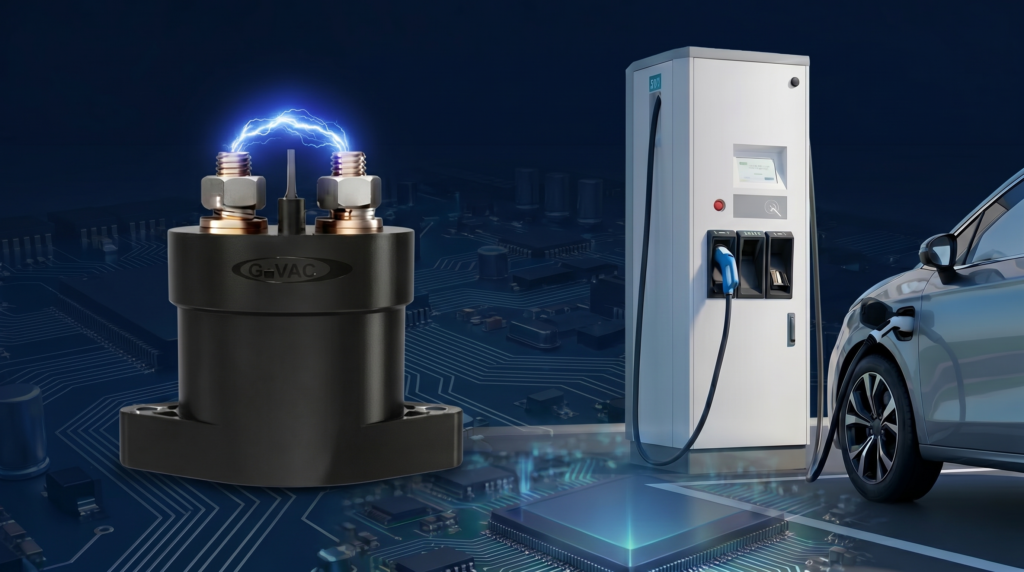
A simple, practical guide for OEM engineers and procurement teams on choosing HVDC contactors
India’s EV charging infrastructure is growing fast. With FAME II incentives and fleet electrification, manufacturers are under pressure to build reliable DC fast chargers (DCFCs) at scale. At the heart of every DC fast charger sits a component that often doesn’t get the attention it deserves: the DC contactor.
Get this component wrong and you risk arc faults, thermal failures, and costly field returns. Get it right and your charger runs safely for tens of thousands of cycles. This guide walks you through the key selection criteria — in plain language.
What Is a DC Contactor for EV Fast Charger Systems ?
A DC contactor is an electromechanical switch designed to make and break high-voltage, high-current DC circuits. Unlike AC contactors — which benefit from natural zero-crossings to extinguish arcs — DC contactors must actively suppress arcs using sealed gas environments, permanent magnets, or specialized contact geometries.
In a DC fast charger, the contactor handles:
- Main circuit isolation between the charger’s power stage and the vehicle battery.
- Fault protection in coordination with the IMD and fuse/breaker.
- Safe pre-charge sequencing to protect capacitor banks from inrush current.
- Bidirectional current flow for V2G and certain charging topologies.
Most field failures trace to three causes: under-rated breaking capacity, poor arc suppression at high voltages, and weak thermal management. The cheapest contactor on the BOM often becomes the most expensive component over the product’s lifetime.
Voltage and Current Ratings for India's DCFC Market
India’s DC fast charging landscape spans a wide range of power levels and connector standards. Understanding the electrical parameters your contactor must handle is the starting point.
| Charger Type | Output Power | Voltage Range | Typical Contactor |
|---|---|---|---|
| Entry DCFC (2W/3W) | 15–30 kW | 200–500V DC | 200A / 500V DC |
| Standard DCFC (Cars) | 30–120 kW | 200–1000V DC | 300A / 1000V DC |
| High-Power DCFC | 120–240 kW | 200–1000V DC | 400–500A / 1000V DC |
| Ultra-Fast / HPC | 240–350 kW+ | 200–1500V DC | 500–600A / 1500V DC |
The most widely used spec in India today is the 300A / 1000V DC contactor — it covers most 60–120 kW chargers supporting both 400V and 800V EV platforms.
How to Select the Right DC Contactor for EV Fast Charger
Why the 300A / 1000V Contactor Is the Sweet Spot
- A 120 kW charger at 400V DC draws 300A — matching the rating exactly.
- At 800V DC, the same 120 kW charger draws only 150A — generous headroom.
- The 1000V rating safely covers both 400V and 800V EV platforms.
- Typically offers 2000A+ maximum breaking capacity for fault protection.
GLVAC (Kunshan GuoLi YuanTong) is a leading manufacturer of HVDC contactors used by major global EV OEMs. Their range covers 20A to 1000A and up to 1500V DC, certified to IATF 16949, IEC, TUV, CE, and UL. Here are the most commonly specified models for EV fast charger applications in India:
| Model | Rated Current | Rated Voltage | Coil Voltage | Best For |
|---|---|---|---|---|
| GLFX150 | 150A | 12–1000V DC | 12V / 24V DC | 30–60 kW chargers |
| GLFX200 | 200A | 12–1000V DC | 12V / 24V DC | 60–80 kW chargers |
| GLFX300 | 300A | 12–1000V DC | 12V / 24V DC | 100–120 kW (most common) |
| GLFX500 | 500A | 12–1000V DC | 12V / 24V DC | 150–240 kW fleet/highway |
| GLFYP600 | 600A | 12–1500V DC | 12V / 24V DC | 350 kW+ ultra-fast (HPC) |
Common GLVAC HVDC Contactor Parameters
- Contact resistance: ≤0.3 mΩ at rated current (GLFX300 reference)
- Dielectric withstand: 2500–4000V AC, 1 minute (coil-to-contact)
- Mechanical endurance: 200,000–300,000 operations
- Electrical endurance: 10,000–100,000 cycles (load-dependent)
- Operating temperature: –40°C to +85°C
- Sealing: Ceramic sealed, leak rate <10⁻⁹ Pa·m³/s
- Arc suppression: Hydrogen-filled chamber + permanent magnet blow-out
- Polarity: Non-polar (bidirectional) — equal performance in both directions
- Certifications: IATF 16949, IEC 61810, TUV, CE, UL
Conclusion
For Indian EV charger OEMs balancing uptime, safety certifications, and competitive pricing, selecting the right HVDC contactor deserves real engineering attention. Remember:
- Rate to maximum voltage, not nominal
- Verify breaking capacity for your specific load type
- Default to non-polar (bidirectional) contactors
- Require IATF 16949 + IEC 61810 + third-party test reports
- Plan for 800V / 1500V DC readiness today
Pantronics India — Authorized Distributor of GLVAC HVDC Contactors
GLVAC’s HVDC contactor portfolio (20A–1000A, 12V–1500V DC) is stocked and supported locally in India with application engineering and after-sales backing.
Frequently Asked Questions (FAQ)
A standard DCFC uses at least two main DC contactors — one on the positive rail, one on the negative — for full isolation. Most designs add a third smaller contactor for the pre-charge circuit. A 60–120 kW dual-gun DCFC typically contains 4–6 DC contactors of varying ratings.
A standard DCFC uses at least two main DC contactors — one on the positive rail, one on the negative — for full isolation. Most designs add a third smaller contactor for the pre-charge circuit. A 60–120 kW dual-gun DCFC typically contains 4–6 DC contactors of varying ratings.
GLVAC (Kunshan GuoLi YuanTong) is a subsidiary of a publicly listed company (SSE STAR 688103) with ~60 years of vacuum technology heritage. Their HVDC range is certified to IATF 16949, IEC, TUV, CE, and UL, and supplies CATL, NIO, VW Group, and others. In India, Pantronics India is the authorized distributor with local stock and application support.
Non-polar (bidirectional) means the arc suppression works equally in both current directions. Polarity-sensitive contactors only suppress arcs well one way. Because EV chargers see varying current directions (pre-charge, V2G), always specify non-polar. GLVAC’s HVDC range is designed for balanced non-polar operation.

Need DC contactor selection assistance?
Get expert guidance on GLVAC HVDC contactors, pre-charge circuits, and arc suppression design — from rating selection and coil drive optimization to short-circuit validation and long-term reliability qualification for EV fast chargers, energy storage, and solar inverters.
Mr. Hemang Dikshit (HVDC Contactor & EV Charging Expert)
Mail ID: h.dikshit@pantronicsindia.com