
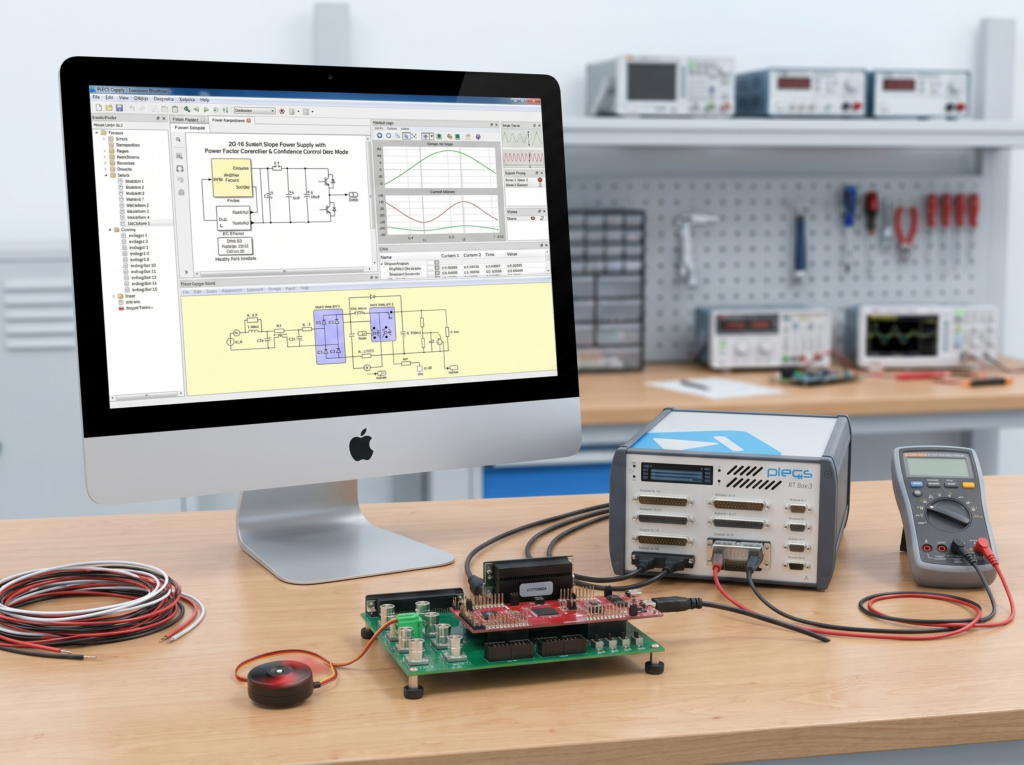
The industry's most trusted simulation platform for power electronics engineers is now smarter, faster, and more connected than ever.
Every power electronics engineer knows the pain: you set up a simulation, hit run, and then, you wait. Switching transients crawl, solver iterations pile up, and what should take minutes stretches into hours. By the time you spot an error, precious development time has already slipped away.
If this sounds familiar, you are not alone. Across R&D labs, universities, and product teams worldwide, slow and inaccurate power electronics simulation remains one of the most expensive bottlenecks in the design cycle. Deadlines slip. Costs balloon. Product launches get pushed.
But there is a better way and engineers across 60+ countries have already found it.
Meet PLECS (Piecewise Linear Electrical Circuit Simulation) by Plexim — the simulation for power electronics that changes everything.
The Real Cost of Traditional Power Electronics Simulation Tools
Before we talk about solutions, let us understand exactly why conventional circuit simulators struggle with power electronics.
Why Traditional Simulators Are Not Built for Power Electronics
Most general-purpose circuit simulators treat power semiconductors IGBTs, MOSFETs, diodes, as highly non-linear elements. Every time a switch transitions between on and off states, the solver must recalculate a complex web of non-linear equations.
This creates several compounding problems for engineers:
- Simulations slow dramatically during switching events, sometimes by 10x to 100x.
- Numerical convergence errors force repeated solver restarts.
- Small timesteps are mandatory near transitions, making long simulation runs impractical.
- Model debugging becomes a time sink instead of a design task.
- High-frequency switching applications — like GaN or SiC-based converters become nearly impossible to simulate efficiently
What Engineers Actually Need From a Power Electronics Simulator Tool
After speaking with hundreds of engineers, the requirements become clear:
- Speed that keeps pace with iterative design.
- Accuracy that holds up under hardware validation.
- Seamless integration with control design workflows.
- Reliable code generation that bridges simulation and production.
- A platform the whole team can trust and standardise on
Introducing PLECS by Plexim: The Gold Standard in Power Electronics Simulation
PLECS (Piecewise Linear Electrical Circuit Simulation) was purpose-built to solve exactly the challenges described above. Developed by Plexim, a Swiss company founded in 2001 with deep roots in power electronics research, PLECS takes a fundamentally different approach to how switching behaviour is modelled.
The Core Innovation: Piecewise Linear Modelling
PLECS models switches as ideal on/off elements with defined topological states, simplifying simulation. Key impacts include:
- Each switching event requires only two integration steps.
- The solver remains stable regardless of switching frequency.
- Simulation speed vastly exceeds that of SPICE-based tools.
- Long simulations, including thermal and steady-state analysis, can be conducted in real time.
Future Trends in Thermal Interface Materials: What's Next
Future trends in Thermal Interface Materials (TIM) are shaped by increasing power densities and the demand for compact, reliable electronics. Key trends for 2025 and beyond include:
- Ultra-high conductivity fillers like boron nitride and graphene (10+ W/m·K)
- Low-pressure dispensing materials for delicate wearables and medical devices.
- Integration with two-phase liquid cooling for data center GPU clusters
Self-healing silicone composites that repair micro-fractures. - Thinner bond lines with improved conductivity for next-gen SiC and GaN power devices.
PLECS Is Not Just a Speed Tool — It Is a Complete Design Platform
Speed alone would make PLECS worth considering. But the platform goes much further than that:
| Feature | What It Means For Your Team |
|---|---|
| Fast Switching Simulation | Simulate high-frequency converters in a fraction of the time of traditional tools. |
| Thermal Modelling | Analyse power losses and device temperatures within the same simulation environment. |
| Control Integration | Design and test control algorithms alongside circuit models — no switching between tools. |
| HIL & Real-Time Simulation | Run PLECS models on real-time targets for hardware-in-the-loop testing. |
| Automatic C Code Generation | Auto-generate production-ready embedded C code directly from your control models. |
| Extensive Component Library | Access a rich library of power electronics components, motors, and machine models. |
| MATLAB/Simulink Compatibility | Use PLECS as a blockset within Simulink or as a fully standalone application. |
Why PLECS Is Trusted by Power Electronics Engineers Worldwide
PLECS is a power electronics simulation tool used globally across industries such as automotive, renewable energy, and aerospace. Trusted by leading companies and institutions, it excels in applications like EV powertrains, solar and wind inverter design, battery management, and aerospace power distribution.
Developed by Plexim, which has over 20 years of expertise, PLECS was created specifically for power electronics, enhancing simulation speed, accuracy, and usability. Engineers report significant benefits, including:
- Reduced simulation times from hours to minutes
- Faster design iteration cycles
- Greater confidence in simulation results before prototyping
- Smooth transition from simulation to production
- A unified platform for team collaboration.
How PLECS Transforms Your Power Electronics Design Workflow
1. Design Smarter: Rapid Iteration From Concept to Validated Design
In the early stages of a power electronics project, engineering teams explore multiple topologies and control strategies. Every iteration that requires waiting hours for simulation results kills momentum and compresses the time available for optimisation.
With PLECS, engineers can simulate dozens of design variations in the time it would take a traditional tool to complete a single run. The piecewise linear approach keeps simulations fast even as circuit complexity grows, so teams can genuinely explore the design space rather than being forced into a single path by simulation constraints.
2. Simulate Faster: From Switching Transients to Thermal Analysis in One Environment
One of the biggest inefficiencies in traditional power electronics development is the fragmentation of the simulation workflow. Electrical simulation happens in one tool, thermal analysis in another, control design in yet another.
PLECS unifies all of these within a single simulation environment. Engineers can analyse switching transients, evaluate thermal behaviour of devices under load, and test control algorithm performance — all in the same model, without data handoffs or format conversions. This level of integration is a genuine competitive advantage in product development.
3. Deploy With Confidence: Auto-Generated, Production-Ready C Codet
The gap between simulation and production often leads to unexpected issues in projects, as control algorithms may not perform as intended due to coding errors. PLECS addresses this by providing automatic C code generation, allowing engineers to design and validate control algorithms in a simulation environment and then directly generate clean, documented embedded C code. This process reduces implementation errors and accelerates the transition from simulation to deployment.
4. Validate Safely: Hardware-in-the-Loop Testing Before You Build
PLECS supports real-time simulation and hardware-in-the-loop (HIL) testing, allowing teams to validate their designs against real control hardware before a single physical prototype is built. This capability is particularly valuable for high-power or safety-critical applications where prototype failures are expensive or dangerous.
PLECS Standalone vs. PLECS Blockset: Choosing the Right Configuration
PLECS Standalone
The standalone version of PLECS operates as an independent simulation environment with its own modelling framework, solver, and post-processing tools. It is ideal for teams that want a dedicated power electronics simulation tool without a dependency on MATLAB or Simulink. The standalone version offers the full suite of PLECS capabilities, including thermal modelling, code generation, and HIL integration.
PLECS Blockset for MATLAB/Simulink
The blockset version integrates PLECS directly into the Simulink environment, allowing engineers to use PLECS circuit models as blocks within their existing Simulink workflows. This configuration is particularly popular with teams that already have significant investment in Simulink-based control design, as it allows them to benefit from PLECS simulation speed while retaining their existing toolchain.
Both configurations share the same core simulation engine and component libraries, so simulation results are consistent regardless of which version your team uses.
Power Electronics
Power Electronics Simulation Applications Where PLECS Excels
AC Drive Systems and Motor Control
PLECS includes comprehensive machine models for induction motors, permanent magnet synchronous motors (PMSM), BLDC motors, and more. Engineers can simulate the complete drive system — power stage, control algorithm, and machine dynamics — in a single model.
Grid-Connected Inverters and Renewable Energy
Solar inverters, wind converters, and grid-tied storage systems all present demanding simulation challenges. PLECS handles multi-level converter topologies, grid impedance models, and complex control strategies including islanding detection and grid-following/grid-forming algorithms — with the speed needed to make these simulations practical.
Battery Management Systems
PLECS is increasingly used for BMS development, particularly for high-voltage automotive and industrial battery systems. The platform supports cell models, pack-level simulation, and the power electronics associated with charging, balancing, and protection circuits.
Wide Bandgap Semiconductor Applications
GaN and SiC devices switch at frequencies and slew rates that overwhelm traditional simulation tools. PLECS handles these devices natively, making it the simulation tool of choice for engineers working with wide bandgap technology.
Power Electronics Simulation Applications Where PLECS Excels
Step 1
Start Your Free 30-Day Trial
Plexim offers a full-featured 30-day free trial of PLECS at plexim.com. The trial includes access to the complete component library, all simulation capabilities, and code generation features — so you can evaluate PLECS against real project work, not a restricted demo environment.
Step 2
Explore the Learning Resources
Plexim provides extensive learning materials for new users, including:
- Step-by-step tutorials covering common power electronics topologies.
- Application notes and example models for a wide range of use cases
- Video guides covering both basic and advanced PLECS features
- A searchable online documentation library
Step 3
Connect With the PLECS Community
PLECS has a vibrant global user community. Engaging with other PLECS users,through forums, webinars, and events organised by Plexim and its partners, is one of the fastest ways to get up to speed and discover best practices.
PLECS in India: Your Authorised Partner Is Pantronics India
For engineers and organisations across India, access to PLECS is provided through Pantronics India — the authorised distributor of Plexim products in the Indian market.
About Pantronics India
Pantronics India is a trusted technology solutions provider serving the Indian engineering community with a strong focus on power electronics, embedded systems, and test & measurement. As the authorised distributor of PLECS by Plexim in India, Pantronics India offers:
- Official PLECS software licences — standalone and blockset versions.
- Competitive pricing tailored to the Indian market, including academic and commercial licences.
- Local technical support from engineers with hands-on PLECS experience
- Training programmes and workshops for individuals and corporate teams
- Integration guidance for teams adopting PLECS within existing MATLAB/Simulink environments
Why Source Through Pantronics India?
Procuring PLECS through an authorised local distributor like Pantronics India ensures you receive genuine licensed software with full manufacturer support, timely local assistance, and access to the latest updates and releases as soon as they become available. For Indian organisations with import and compliance requirements, working with a local authorised partner also simplifies the procurement and licensing process.
Conclusion: The Power Electronics Simulation Tool Your Team Deserves
The development of high-performance power electronics products has never been more demanding. Faster switching frequencies, tighter efficiency targets, shrinking development timelines, and the growing complexity of systems incorporating GaN, SiC, and advanced control algorithms — these challenges are pushing traditional simulation tools well beyond their limits.
PLECS by Plexim was built for exactly this moment. Its piecewise linear approach to simulation, its integrated thermal and control modelling, its reliable code generation, and its proven performance across thousands of real-world applications make it the power electronics simulator tool that today’s engineering teams need.
Whether you are designing the next generation of EV powertrains, developing high-efficiency industrial drives, or advancing renewable energy inverter technology, PLECS gives you the speed, accuracy, and confidence to design smarter, simulate faster, and deploy with confidence.
For users in India, contact Pantronics India — the authorised distributor of PLECS by Plexim — for licensing, pricing, training, and local technical support.
Frequently Asked Questions About PLECS Power Electronics Simulation
Yes. While PLECS is powerful enough for advanced research and professional product development, its intuitive interface and comprehensive library make it accessible to engineers at all experience levels. Plexim also provides extensive tutorials and support resources specifically designed to help new users get productive quickly.
SPICE-based tools were designed for general circuit simulation, not specifically for power electronics with high-frequency switching. PLECS consistently delivers faster simulation times for power electronics applications because its piecewise linear modelling approach is fundamentally better suited to the switching behaviour that characterises these circuits. For power electronics work, PLECS is a purpose-built tool rather than a generalised one adapted to the task.
Yes. PLECS Blockset integrates directly with Simulink, allowing you to use PLECS circuit models within your existing Simulink-based workflow. The PLECS standalone version can also exchange data with MATLAB through scripting interfaces.
PLECS generates clean, readable, production-ready ANSI C code from control models. The generated code is suitable for direct deployment on embedded targets and is compatible with a wide range of microcontrollers and DSPs used in power electronics applications.
Yes. Plexim offers a full-featured 30-day free trial of PLECS. Visit plexim.com to download and start your trial. Indian users can also contact Pantronics India directly for local support during their evaluation.

Need simulation assistance?
For expert guidance on PLECS by Plexim, connect with Mr. V. N. Sudharsan, Technical Specialist at Pantronics India Pvt. Ltd. He supports engineers and R&D teams with PLECS software evaluation, trial setup, thermal and loss modelling, control validation, HIL simulation, and embedded code generation. If you are developing EV chargers, BESS, motor drives, solar inverters, or advanced power conversion systems, get application-focused support to reduce design time and improve simulation accuracy.
Mr. V. N Sudharsan (Technical specialist)
Mail ID: sudharsan@pantronicsindia.com