Plexim
Plexim GmbH, located in Zurich, Switzerland, is a leader in simulation tools for power electronics and electrical drive systems. Since 2002, Plexim has created the well-known PLECS platform, which is widely used for designing electric vehicles, renewable energy systems, industrial drives, and power converters. Their solutions, which include PLECS, PLECS Coder, and RT Box, help engineers and researchers in various industries and academia speed up development, conduct real-time testing, and achieve smooth hardware integration.
Pantronics India Pvt. Ltd. is the only developer and authorized distributor of Plexim products in India. They provide complete support, training, and integration services for power electronics simulation and testing.
PLECS Simulation Software
Pantronics India Pvt. Ltd. is the only developer and authorized distributor of Plexim’s PLECS simulation tools in India. It provides innovative solutions for power electronics modeling and real-time simulation.
Explore Plexim's Product Portfolio
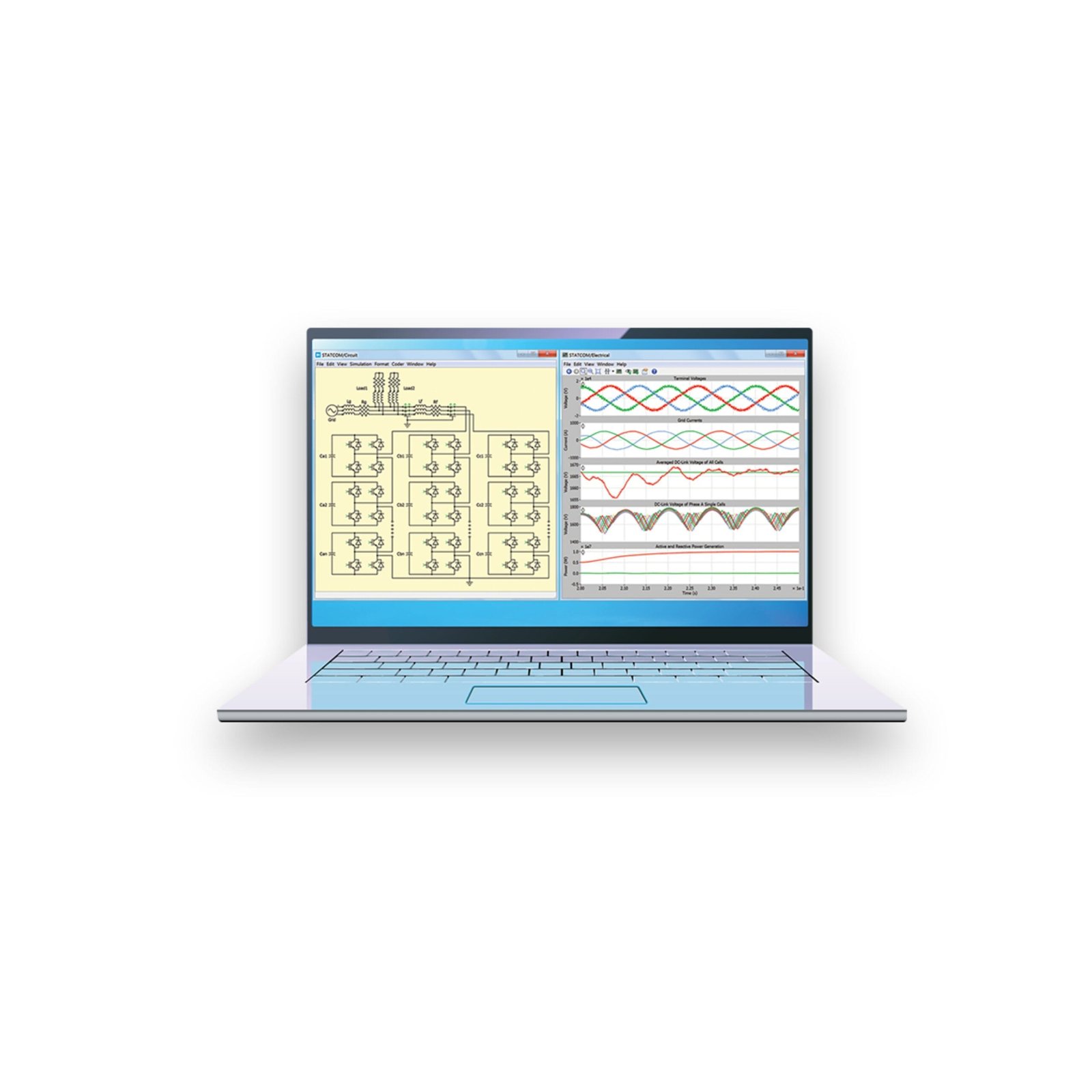
PLECS – Power Electronics Circuit Simulator
PLECS is simulation software designed for modeling and analyzing complex power electronic systems, electrical drives, and embedded control applications. Developed by Plexim and exclusively distributed in India by Pantronics, PLECS streamlines the design and testing process for engineers working on motor drives, converters, renewable energy systems, and electric vehicles (EVs).
PLECS comes in two editions to cater to different simulation needs:
- PLECS Standalone – A fast, lightweight simulation platform that works independently of MATLAB®/Simulink®. It is ideal for real-time testing, rapid development, and system-level validation.
- PLECS Blockset – This edition integrates directly with MATLAB®/Simulink®, offering modeling capabilities for detailed and large-scale simulations.
Model-based development in the automotive and industrial sectors
Designed for power electronics, PLECS supports thermal, control, and magnetic modeling with an easy-to-use, component-based workflow. Its quick simulation speed and flexible environment make it perfect for: – Electric vehicle system simulation – Solar and wind inverter development – Embedded controller design and validation – Thermal analysis of power semiconductor devices – Model-based development in the automotive and industrial sectors
- Electric vehicle system simulation
- Solar and wind inverter development
- Embedded controller design and validation
- Thermal analysis of power semiconductor devices
Key Features:
- Available as Standalone or MATLAB®/Simulink® Blockset
- Integrated modeling of power, control, thermal, and magnetic systems
- Built-in component libraries for converters, filters, machines, and more
- Optimized for real-time simulation and HIL workflows
- Scalable from concept design to embedded implementation
PLECS Standalone Packages
Explore Autonomous Power Simulation with PLECS Standalone
If you require a simulation tool that functions independently from other tools, PLECS Standalone is a complete solution. This is a standalone tool for power electronic systems time–domain simulations, and provides a comprehensive framework to model more complex electrical circuits and control systems strategies independently from other platforms.
Faster, More Efficient Simulation Engine
When compared to PLECS Blockset, PLECS Standalone is much quicker due to a more advanced simulation engine. PLECS Standalone includes a powerful library of blocks, and is an excellent and inexpensive tool for falling quicker. The tool appropriately matches its use, and affords dynamic system simulations in both industry and academia.
Advanced Solvers for Different System Types
PLECS Standalone provides its own solvers to properly implement circuit equations. You can select between fixed-step or variable-step solvers, depending on your physical situation. If your system is designed with dynamic change, then one of PLECS Standalone‘s variable time-step solvers—either implicit or explicit—can achieve efficient and accurate simulations for both stiff and non-stiff models.
Smooth Simulations of Sampled Data Systems
Whether your sampled data systems are periodic, variable, or mixed in their sampling rates, PLECS Standalone can effectively model the procedures. Completing the model includes smooth operation of discrete and continuous optimization.
System Requirements
| Platform | Operating System |
|---|---|
| Windows | Windows 10 64-bit or newer |
| Mac / Intel | macOS 10.15 or newer |
| Mac / ARM | macOS 12 or newer |
| Linux | Kernel 2.6 64-bit / glibc 2.15 / libX11 (Xlib) 6.2.1 or newer, libncurses5.x |
PLECS Blockset
PLECS Blockset is a dedicated toolbox for rapid and efficient simulation of power electronics systems in the Simulink environment. PLECS Circuit Blocks provide access to PLECS electrical circuit models and allow for connections to Simulink control algorithms for unified system simulation.
Integrated PLECS Circuit Blocks
In the Simulink model, each electrical circuit created in PLECS is represented as a single PLECS Circuit Block. PLECS Circuit Blocks can accept input signals to control electrical sources or switching devices and provide outputs through ports for measurement data, such as visualizing the data with scopes or analyzing the data in MATLAB or feedback control loops.
Users have complete access to Simulink‘s libraries and extensions, allowing for the development of sophisticated control strategies and seamless integration of multi-domain systems.
Easy–to–Use Schematic Editor
If you have experience in Simulink, then moving to the PLECS schematic editor is very easy. If you double–click a Circuit Block, you will open the editor and be able to drag and drop to create and connect components. The basic design of the interface is intuitive; you can add input/outputs to the schematic to specify how the system is to interact.
Native Use of Simulink Solvers
During simulation, PLECS automatically converts circuit designs into a set of equivalent mathematical equations. These equations are then solved directly by the Simulink engine, eliminating the need for co-simulation. The PLECS Blockset supports both fixed-step and variable-step solvers, ensuring high compatibility with Simulink’s simulation configurations.
System Requirements
| Platform | MATLAB Version | Operating System |
|---|---|---|
| Windows | 9.2 ... 25.2 | Windows 10 64-bit or newer |
| Mac | 9.2 ... 25.2 | macOS 10.15 or newer |
| Linux | 9.2 ... 25.2 | Kernel 2.6 64-bit / glibc 2.15 / libX11 (aka Xlib) 6.2.1 or newer, libncurses5.x |
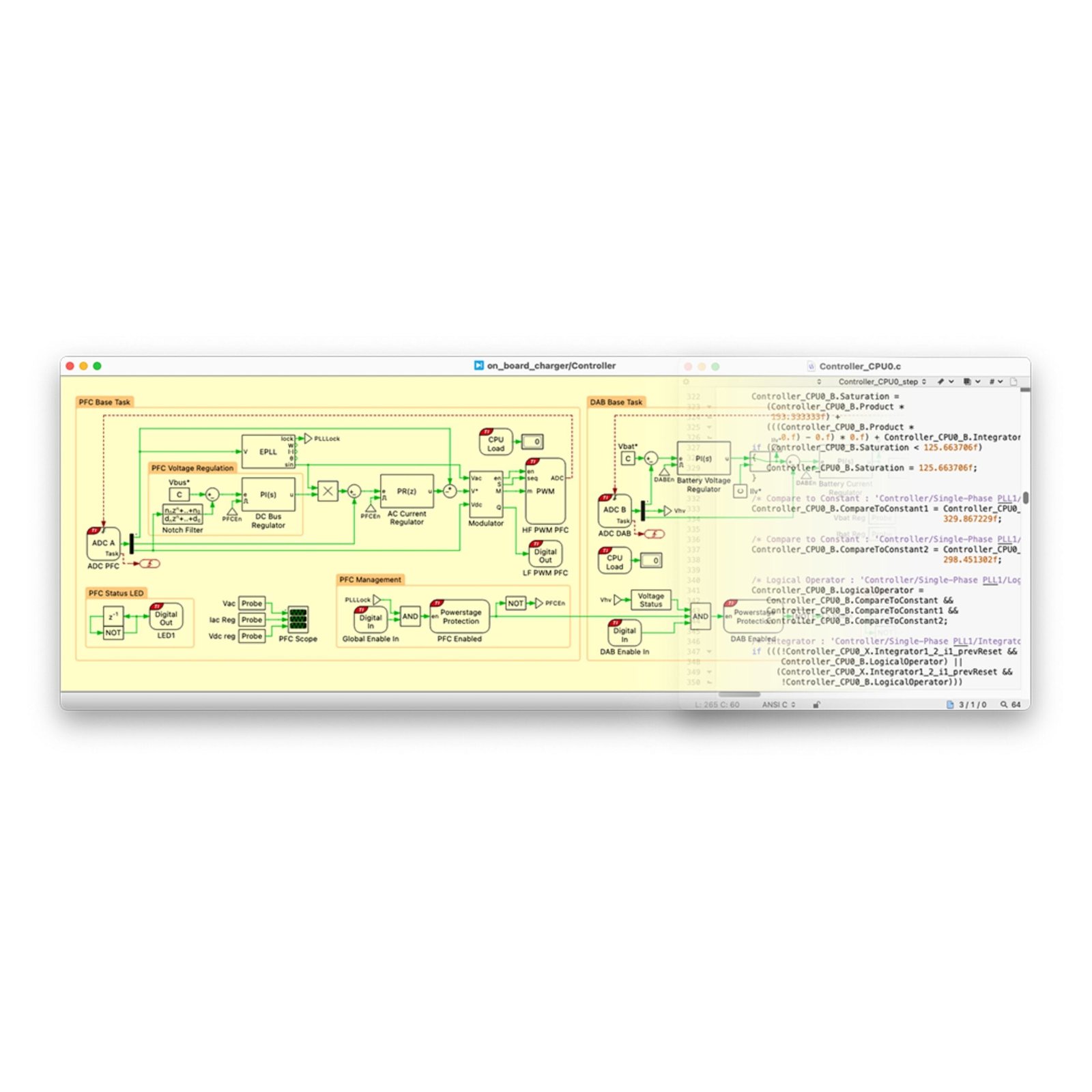
PLECS Coder – Code Generation for Power Electronics Microcontrollers
PLECS Coder is a fast, easy-to-use tool for generating embedded code directly from your control schematic, without the need for hand-coding. It is designed for engineers working on power electronics and electrical drive applications. It allows for smooth graphical programming of microcontrollers with integrated peripheral support.
With dedicated blocks for PWM, ADC, and GPIOs, PLECS Coder makes hardware configuration straightforward and helps you design nested control loops effortlessly. Its offline peripheral models allow for accurate simulation within the PLECS environment. This feature is perfect for quick testing, debugging, and deployment.
Whether you are working with TI C2000, STMicro STM32, or Infineon XMC families, PLECS Coder supports fast migration and multitasking control design, all within a single toolchain. It enables you to upload, run, and interact with live controller data in real time, improving your entire embedded development workflow.
Key Benefits:
- No manual coding – drag-and-drop control logic design
- Offline models simulate microcontroller behavior for early validation
- Supports live parameter tuning and signal monitoring
- Fast code generation and deployment to target MCUs
- Built-in compatibility with C2000, STM32, and XMC devices
- Accelerates development of inverters, drives, and converter systems


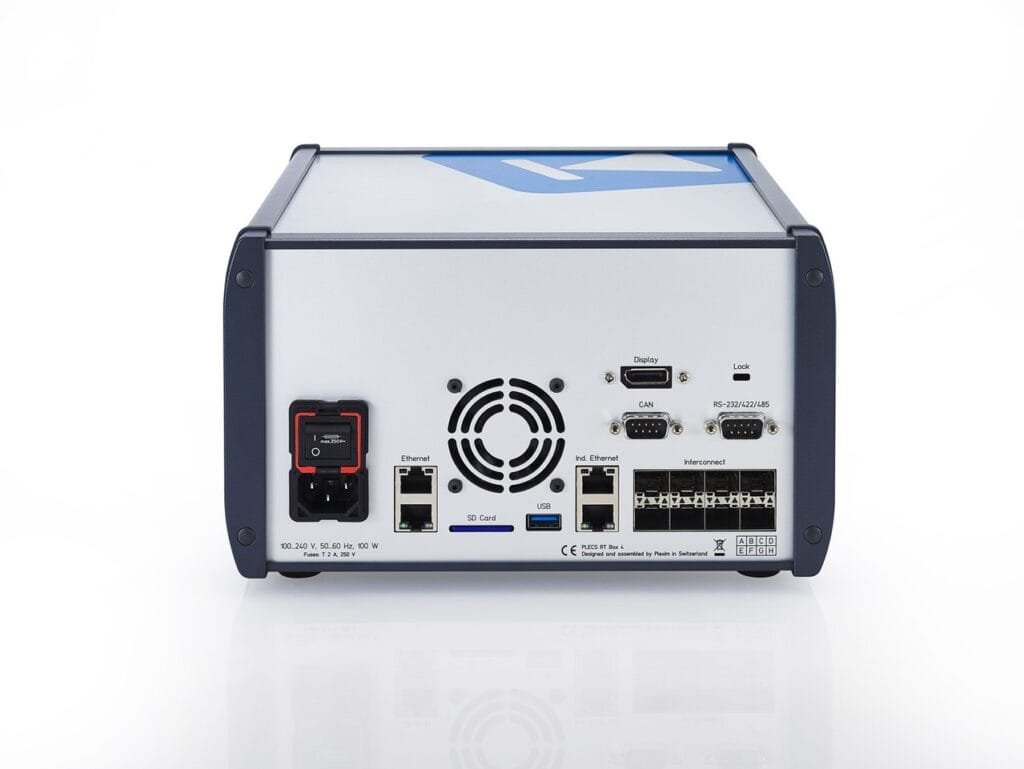
RT Box – Advanced HIL Simulator for Power Electronics
RT Box is a high-performance HIL simulator for power electronics applications, designed to deliver precise, real-time testing for control systems. With its advanced features and integration with the PLECS simulation platform, RT Box provides engineers with a reliable solution for both Hardware-in-the-Loop (HIL) simulation and Rapid Control Prototyping (RCP).
Hardware-in-the-Loop (HIL) Simulation for Power Electronics
HIL simulation using RT Box allows seamless interaction between real controllers and simulated power circuits. This enables developers to safely test control strategies under both typical and fault conditions, without risking damage to physical hardware.
Real-time simulation is particularly challenging in power electronics due to rapid switching and short time constants. The RT Box overcomes these challenges with cutting-edge features like:
- Sub-cycle averaging for accurate PWM interpretation
- Nanostep technology for ultra-fast processing
- Nanosecond-resolution sampling of PWM signals
These technologies enable simulations at switching frequencies of several hundred kHz with minimal latency, offering exceptional fidelity in your HIL simulator setup.
Rapid Control Prototyping (RCP)
When the final controller hardware is unavailable, RT Box steps in as a temporary controller. It can:
- Generate complex PWM signals
- Read sensor data through analog inputs
- Interface with encoders and resolvers for motor control
- Communicate using SPI, CAN, and other protocols
This capability is especially valuable in R&D environments, where testing the power stage must proceed before hardware finalization.
Parallel Computing with CPU and FPGA
At its core, the RT Box HIL simulator features a Xilinx Zynq chip, combining multiple CPU cores and an FPGA. This hybrid architecture enables:
- Flexible model partitioning
- Parallel computation across CPU and FPGA
- Multiple solver options:
- CPU Solver: For general PLECS models, supporting time steps above 1 µs
- FlexArray Solver: Ideal for multi-level converters, down to 250 ns time steps
- Nanostep Solver: Handles MHz-level switching for resonant converters and dual active bridges
Solver Performance and Availability:
| RT Box CE | RT Box 1 | RT Box 2 | RT Box 3 | RT Box 4 | |
|---|---|---|---|---|---|
| Processor | Xilinx Zynq | Xilinx Zynq | Xilinx Zynq | Xilinx Zynq Ultrascale+ | Xilinx Zynq Ultrascale+ |
| CPU clock rate | 1 GHz | 1 GHz | – | 1.5 GHz | 1.5 GHz |
| Solvers | – | – | – | – | – |
| ↳ CPU | 1 core | 1 core | – | 3 cores | 3 cores |
| ↳ FlexArray | – | – | – | ✓ | ✓ |
| ↳ Nanostep | 1 unit (7.5 ns) | 1 unit (7.5 ns) | – | 2 units (4 ns) | 2 units (4 ns) |
Nanostep® Solver – True Nanosecond Precision
Unlike conventional simulators, RT Box uses Nanostep to perform PWM sampling, current/voltage computation, and zero-crossing detection within a single FPGA clock cycle. This breakthrough ensures accurate modeling of converters, even during frequent current zero-crossings.
Applications include:
- Dual active bridges
- LLC and phase-shifted full-bridge converters
- Buck and boost converters
- 3-phase inverters operating up to 1 MHz
Scalable HIL Simulation Clusters
Multiple RT Boxes can be interconnected via multi-gigabit optical links to build large-scale HIL simulation clusters. This makes it possible to simulate complex systems such as:
- Modular multilevel converters (MMCs)
- Microgrid environments
Fast Model Deployment
Circuit models created in PLECS can be compiled and uploaded to RT Box in seconds—no manual FPGA programming or long bitstream generation required.
Software Licenses
No third-party tools are necessary. Required licenses include:
- PLECS Standalone or Blockset
- PLECS Coder
Interface Options
Easily connect external systems using:
- Analog and Digital Breakout Boards
- LaunchPad-Nucleo Interface
- ControlCard Interface
Why Choose RT Box as Your HIL Simulator in India?
- Blazing Speed: Fastest HIL simulator tailored for power electronics
- Seamless Integration: Works natively with the PLECS platform
- Cost-Effective: Advanced features at a competitive price
- Ideal for India’s Growing Market: Perfect HIL simulator in India for academic, industrial, and R&D use
Which RT Box Model is Right for Me?
| Model | Target Audience |
|---|---|
| RT Box CE | Classroom and lab teaching |
| RT Box 1 | Versatile and scalable for HIL and RCP |
| RT Box 2 | Multi-core and FPGA for faster, higher complexity circuits |
| RT Box 3 | Increased I/O for multi-level converters and microgrids |
| RT Box 4 | Ultra-low latency analog outputs with an update rate of 125 Msps |
Explore RT Box Products

Website
- Home
- Our Principals
- COOLIT
About Us
- <span data-metadata=""><span data-buffer="">About us
- <span data-metadata=""><span data-buffer="">Our Customers
- <span data-metadata=""><span data-buffer="">Customers Testimonials
- Principal Testimonials
Get in touch
- Address: A - 9, Sector - 67, Noida, U.P. - 201301 (India)
- Email sales@pankaj.biz
- Call us +91 7840051401
Resources
- Blogs
- Download Centre