
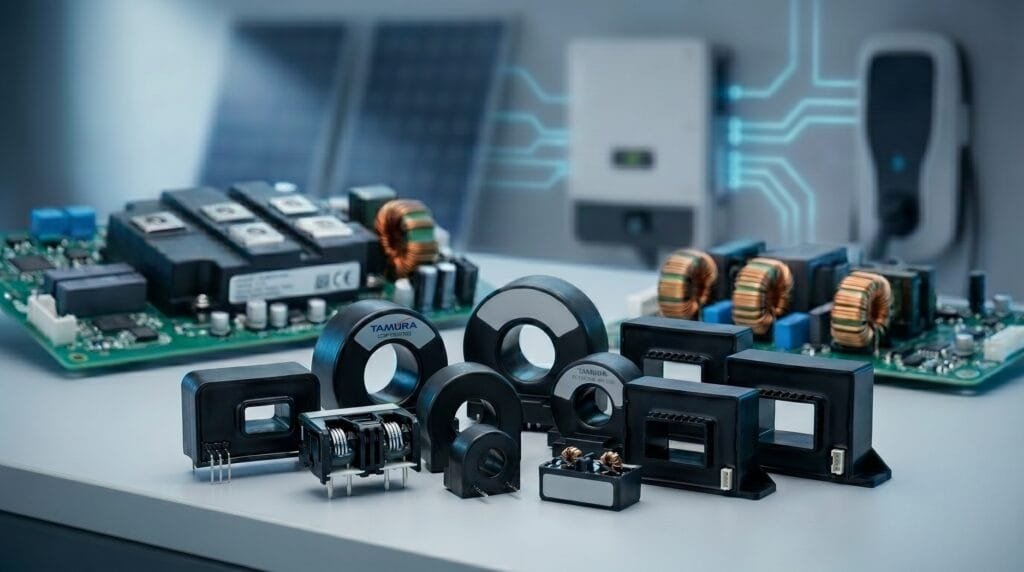
Open Loop Current Sensor
The rapid growth of electric vehicles (EVs), battery energy storage systems (BESS), renewable energy installations, industrial automation, and advanced motor drives has significantly increased the importance of accurate current measurement in modern power electronics. As power systems become more efficient, intelligent, and safety-critical, engineers require reliable methods to monitor current flow in real time.
Current sensing is no longer limited to basic measurement. It directly influences battery performance, motor control accuracy, system protection, thermal management, and overall energy efficiency. Whether in a solar inverter, EV traction inverter, industrial variable frequency drive (VFD), or UPS system, accurate current feedback enables controllers to make critical operating decisions.
Among the various current sensing technologies available today, the Open Loop Current Sensor has become one of the most widely adopted solutions due to its balance of electrical isolation, performance, compact size, and cost-effectiveness.
Why Accurate Current Measurement Matters
In power electronic systems, current is a key control and protection parameter. Inaccurate measurements can lead to reduced efficiency, incorrect control decisions, false fault detection, battery degradation, overheating, and even equipment failure.
For example, in an EV battery management system, current data is used to estimate state-of-charge (SOC) and battery health. In motor drives, current feedback determines torque control and operational efficiency. In renewable energy systems, current monitoring helps maximize power conversion efficiency while protecting equipment from overload conditions.
As power densities increase and systems operate at higher voltages, reliable Current Monitoring has become essential for ensuring both performance and safety.
What Is an Open Loop Current Sensor?
An Open Loop Current Sensor is a non-contact Hall Effect Current Sensor that measures AC or DC current by detecting the magnetic field generated around a current-carrying conductor.
Unlike shunt resistors, which require direct electrical connection within the current path, open-loop sensors use Hall Effect Technology to measure current indirectly. This provides complete galvanic isolation between the power circuit and the control electronics, making them particularly valuable in high-voltage applications.
The basic architecture consists of:
- A primary conductor carrying current
- A magnetic core that concentrates magnetic flux
- A Hall sensing element
- Signal conditioning electronics
- An output stage
This configuration enables safe and reliable current measurement while minimizing power loss
How an Open Loop Current Sensor Works
The operating principle is based on the Hall Effect.
- Current flowing through a conductor generates a magnetic field.
- A magnetic core captures and concentrates the magnetic flux.
- The Hall sensing element detects the magnetic field strength.
- The Hall element generates a voltage proportional to the magnetic flux density.
- Internal electronics amplify and condition the signal.
- The sensor outputs a voltage or current signal proportional to the measured current.
Because the Hall element responds directly to magnetic field strength, open-loop sensors can measure both AC and DC currents while maintaining electrical isolation.
Key Technical Parameters Engineers Evaluate
Selecting the right Current Measurement Sensor requires understanding the specifications that influence performance.
Accuracy
Many open-loop Hall Effect sensors provide typical accuracy levels between ±1% and ±2% of full scale, although performance varies by model and operating conditions.
Offset Error
Offset error represents the output deviation when no current is present. Excessive offset can affect low-current measurement accuracy.
Temperature Drift
Changes in temperature can influence Hall element characteristics and magnetic core properties. High-quality sensors incorporate compensation techniques to minimize drift.
Bandwidth and Response Time
Motor drives, inverters, and switching power supplies often require fast current measurement. Modern open-loop sensors can offer microsecond-level response times and bandwidths suitable for dynamic applications.
Isolation Voltage
Electrical isolation is a critical requirement in EVs, renewable energy systems, and industrial equipment. Isolation ratings vary by sensor design and application requirements.
EMC Performance
Power electronics environments contain significant electromagnetic noise. Good EMC performance helps maintain measurement accuracy under challenging operating conditions.
Open Loop Sensors vs Alternative Technologies
Engineers commonly evaluate three major current sensing technologies.
| Feature | Open Loop Hall Sensor | Closed Loop Hall Sensor | Shunt Resistor |
|---|---|---|---|
| Isolation | Yes | Yes | No |
| Accuracy | Good | Very High | High |
| Cost | Moderate | Higher | Low |
| Power Loss | Very Low | Very Low | Higher |
| AC/DC Measurement | Yes | Yes | Yes |
| Temperature Stability | Good | Excellent | Moderate |
Open-loop sensors are often selected when designers require electrical isolation, low power loss, and cost-effective current measurement. Closed-loop sensors provide higher accuracy but at greater cost and complexity, while shunt resistors offer a low-cost solution when isolation is not required.
Although widely used, open-loop sensors are not ideal for every application.
Engineers should consider several limitations:
- Accuracy is generally lower than closed-loop Hall Effect sensors.
- Temperature variations can introduce measurement drift.
- Strong external magnetic fields may influence performance.
- Magnetic core saturation can occur under extreme overload conditions.
- Mechanical positioning can affect measurement consistency.
For ultra-high-precision applications such as precision metering or laboratory instrumentation, closed-loop or fluxgate technologies may be more suitable
When selecting an Industrial Current Sensor, engineers should evaluate:
- Current range and overload capability
- Required measurement accuracy
- Isolation voltage requirements
- Operating temperature range
- Bandwidth and response time
- Mechanical mounting constraints
- Environmental conditions such as vibration and EMI exposure
For example, a 150A EV traction inverter requires strong isolation, high overload capability, and fast response characteristics. A solar inverter may prioritize long-term stability and environmental robustness.
Although widely used, open-loop sensors are not ideal for every application.
Engineers should consider several limitations:
- Accuracy is generally lower than closed-loop Hall Effect sensors.
- Temperature variations can introduce measurement drift.
- Strong external magnetic fields may influence performance.
- Magnetic core saturation can occur under extreme overload conditions.
- Mechanical positioning can affect measurement consistency.
For ultra-high-precision applications such as precision metering or laboratory instrumentation, closed-loop or fluxgate technologies may be more suitable
For decades, Tamura has been a recognized supplier of current sensing solutions used in industrial automation, renewable energy systems, automotive electronics, battery management systems, and power conversion equipment.
Known for manufacturing consistency, robust engineering, and reliable performance, Tamura sensors are widely adopted in applications where long-term stability, electrical isolation, and dependable operation are critical design requirements.
Pantronics India Pvt. Ltd., the authorized distributor of Tamura in India, supports OEMs, design engineers, system integrators, and procurement teams with genuine Tamura products, application guidance, and reliable sourcing support.
By combining technical expertise with dependable supply chain management, Pantronics helps customers select the right current sensing solution while reducing procurement and implementation risks.
As electrification, renewable energy deployment, and industrial automation continue to expand, accurate current measurement has become a fundamental requirement for modern power electronics. The Open Loop Current Sensor provides an effective balance of Hall Effect-based measurement, galvanic isolation, fast response, compact design, and cost-efficient implementation.
While engineers must consider factors such as accuracy, temperature drift, and application requirements, open-loop sensors remain one of the most practical and widely used Current Sensing Solutions for EVs, solar inverters, battery energy storage systems, motor drives, robotics, UPS systems, and industrial automation equipment.
For organizations seeking proven and reliable current sensing technology, Tamura’s sensor portfolio and Pantronics India’s technical and sourcing support offer a strong foundation for successful power electronics design and deployment.
Frequently Asked Questions (FAQ)
An open loop current sensor is a non-contact Hall Effect device that measures AC or DC current by detecting the magnetic field generated around a current-carrying conductor. When current flows through the primary conductor, it creates a magnetic field that is concentrated by a magnetic core. A Hall sensing element inside the sensor detects this field and generates a voltage proportional to it. Internal electronics then condition and amplify this signal into a usable output — all without any direct electrical connection to the power circuit, providing complete galvanic isolation.
Both technologies use Hall Effect sensing, but they differ in how the output is generated. An open loop sensor measures the magnetic field directly and outputs a proportional voltage signal. It is compact, cost-effective, and suitable for most industrial and power electronics applications. A closed loop sensor uses a feedback winding to actively cancel the magnetic field, producing a more precise output with lower temperature drift. Closed loop sensors offer higher accuracy (typically better than ±0.5%) but cost more and are physically larger. Open loop sensors are preferred when cost, size, and moderate accuracy (±1–2%) are the primary design criteria.
Yes. Because the operating principle is based on magnetic field detection via the Hall Effect, open loop current sensors can measure both AC and DC currents, as well as complex pulsed or transient waveforms. This makes them particularly well suited for applications like EV traction inverters, solar inverters, battery management systems, and variable frequency drives (VFDs), where the current waveform is rarely a simple AC sine wave.
Most open loop Hall Effect current sensors provide typical accuracy in the range of ±1% to ±2% of full scale under normal operating conditions. Actual accuracy depends on factors including offset error, temperature drift, supply voltage stability, and external magnetic interference. For applications requiring tighter measurement accuracy — such as precision energy metering or laboratory instrumentation — closed loop or fluxgate-based sensors are generally recommended. For EV systems, motor drives, solar inverters, and industrial automation, open loop accuracy levels are well within acceptable limits.
Selecting the correct sensor involves evaluating several parameters together. Start with the nominal current range and ensure the sensor can handle expected overload conditions without core saturation. Next, confirm the isolation voltage rating meets your system’s safety requirements — this is especially critical in high-voltage EV and renewable energy applications. Check the bandwidth and response time if your application involves fast-switching inverters or dynamic current control. Finally, consider the operating temperature range, mechanical mounting format, and EMC environment. For industrial and power electronics applications, Tamura’s open loop current sensor range — available through Pantronics India — covers a broad spectrum of these requirements with proven long-term reliability.

Need Help Selecting the Right Current Sensor for Your Application?
Ms. Sunita Joshi is a Current Sensor and Power Electronics Specialist at Pantronics India Pvt. Ltd., the authorized distributor of Tamura current sensing solutions in India. With deep expertise in Hall Effect current measurement, galvanic isolation, and sensor selection for high-voltage applications, she supports OEM design engineers, system integrators, and procurement teams across EV, solar inverter, battery management, and industrial motor drive projects.
Ms. Sunita Joshi (Current Sensor & Power Electronics Specialist )
Mail ID: s.joshi@pantronicsindia.com