
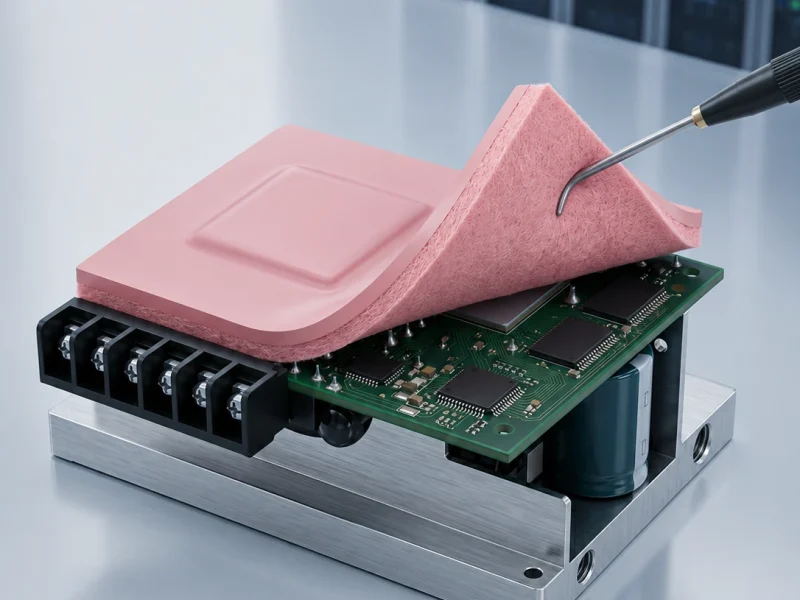
As electronic systems continue to become more compact and power-dense, effective thermal management is no longer optional — it’s essential. While heatsinks are designed to dissipate heat, microscopic air gaps between components and cooling surfaces often create unwanted thermal resistance that limits their performance. This guide explains how thermal silicone soft pads improve thermal performance, reduce contact resistance, provide electrical insulation, and help engineers select the right solution for applications ranging from consumer electronics to EV power systems.
Every electronic component that consumes power generates heat. If this heat is not transferred efficiently, semiconductor junction temperatures increase, reducing efficiency, accelerating material degradation, and shortening component lifespan.
Although heatsinks remove heat from electronic devices, they cannot perform efficiently unless they make intimate contact with the heat source. Even precision-machined metal surfaces contain microscopic peaks and valleys that trap air when assembled. Since air has a thermal conductivity of only 0.026 W/m·K, these tiny pockets act as highly effective thermal insulators.
Thermal Interface Materials (TIMs) are designed to eliminate these air gaps by creating a continuous thermal path between the heat-generating component and the heatsink. By reducing thermal contact resistance, TIMs improve heat dissipation, lower operating temperatures, and enhance the long-term reliability of electronic systems
How Thermal Conductivity and Thermal Resistance Affect Heat Transfer
Heat transfer through a thermal interface follows Fourier’s Law of Heat Conduction:
Q = (k × A × ΔT) / L
- Q = Heat transfer rate (W)
- k = Thermal conductivity (W/m·K)
- A = Contact area (m²)
- ΔT = Temperature difference (°C or K)
- L = Thermal path thickness (m)
The equation demonstrates that increasing thermal conductivity and contact area improves heat transfer, while increasing material thickness raises thermal resistance.
Engineers often evaluate interface performance using thermal resistance:
R = L / (k × A)
However, the total thermal path is more accurately represented as:
Rₜₒₜ₊ₓ = Rcontact₁ + RTIM + Rcontact₂
This means the thermal pad itself is only one part of the overall thermal resistance. The contact resistance between the component and the pad, and between the pad and the heatsink, can have an equally significant impact on cooling performance.
Why High Thermal Conductivity Alone Doesn't Guarantee Better Cooling
A common misconception is that selecting the highest thermal conductivity automatically produces the best thermal performance. In reality, thermal conductivity is only one design parameter.
A thermal pad with moderate conductivity that conforms perfectly to uneven surfaces may outperform a higher-conductivity material that leaves microscopic air gaps. Likewise, excessive pad thickness increases the heat transfer path, while insufficient mounting pressure prevents proper surface contact.
For this reason, engineers should evaluate thermal interface materials based on the complete thermal system rather than conductivity values alone. Factors such as surface conformity, compression behaviour, bond line thickness, and contact pressure often have a greater influence on overall thermal performance than conductivity alone.
Thermal silicone soft pads are engineered to provide an optimal balance between thermal conductivity, electrical insulation, mechanical compliance, and manufacturing reliability.
Available thermal conductivity grades range from 1.5 W/m·K to 8.0 W/m·K, enabling engineers to select materials based on thermal requirements, assembly conditions, and cost targets.
| Product Series | Thermal Conductivity |
|---|---|
| TC-SP-1.7 | 1.5 W/m·K |
| TC-CA-10 | 1.8 W/m·K |
| TC-CA-10D | 2.3 W/m·K |
| TC-CAD-10 | 3.2 W/m·K |
| TC-CAT-20 | 4.5 W/m·K |
| TC-CAF-40 | 5.2 W/m·K |
| TC-PEN-310 | 3.2 W/m·K |
| TC-PEN-520 | 5.2 W/m·K |
| TC-UP8 | 8.0 W/m·K |
These materials are tested using recognized standards such as ISO 22007-2 for thermal conductivity and JIS K6249 for dielectric breakdown voltage and hardness, ensuring consistent and repeatable material performance.
Beyond conductivity, thermal silicone soft pads also provide excellent mechanical flexibility, making them suitable for applications where manufacturing tolerances create uneven gaps between components and heatsinks.
How Surface Conformability Reduces Thermal Contact Resistance
In practical electronic assemblies, PCB warpage, machining marks, solder joint height variation, and component tolerances create non-uniform gaps that reduce effective surface contact.
Rigid interface materials only touch the highest points of these surfaces, leaving air-filled voids that increase thermal resistance.
Thermal silicone soft pads compress under mounting pressure and conform to these microscopic irregularities, increasing the effective contact area while minimizing trapped air.
This results in:
- Lower thermal contact resistance
- Improved heat transfer efficiency
- More uniform temperature distribution
- Reduced semiconductor junction temperatures
- Enhanced long-term reliability
For many applications, improving contact resistance delivers greater thermal benefits than simply increasing thermal conductivity.
Mechanical compliance is just as important as thermal conductivity.
Thermal silicone soft pads are available with Asker C hardness values ranging from approximately 2 to 40, allowing engineers to select the appropriate balance between softness and structural stability.
Pads that are too rigid may fail to fill microscopic gaps, while excessively soft materials may deform under prolonged clamping pressure. Proper compression helps maintain consistent contact pressure, minimizes hot spots, reduces mechanical stress on sensitive semiconductor packages, and improves performance during thermal cycling.
Many grades also provide dielectric breakdown voltages between 10 kV and 22 kV, allowing efficient heat transfer while maintaining electrical isolation. This makes them well suited for IGBT modules, MOSFETs, EV battery systems, DC-DC converters, industrial motor drives, power supplies, and telecommunications equipment.
Selecting the right thermal interface material requires evaluating the complete application rather than relying on conductivity ratings alone. Engineers should consider:
- Actual gap thickness between the component and heatsink
- Required thermal conductivity
- Mounting pressure and compression characteristics
- Electrical insulation requirements
- Operating temperature
- Long-term reliability objectives
A common design mistake is selecting an unnecessarily thick thermal pad. While thicker materials can bridge larger gaps, they also increase thermal resistance by extending the heat transfer path.
The ideal thermal pad should completely fill the mechanical gap while compressing sufficiently to minimize bond line thickness and maximize surface contact. Typical application guidelines include:
| Application | Recommended Thermal Conductivity |
|---|---|
| Consumer Electronics | 1–3 W/m·K |
| LED Lighting | 2–4 W/m·K |
| Telecommunications Equipment | 3–5 W/m·K |
| Industrial Automation | 3–5 W/m·K |
| Power Supplies | 3–5 W/m·K |
| IGBT Modules | 4–8 W/m·K |
| EV Battery Systems | 4–8 W/m·K |
| High-Power Converters | 5–8 W/m·K |
Final material selection should always be based on actual assembly conditions, thermal requirements, and reliability goals rather than conductivity values alone.
Many thermal design issues arise from focusing on a single material property instead of the complete thermal interface.
Choosing the highest thermal conductivity does not guarantee the lowest operating temperature if contact resistance remains high. Similarly, selecting an excessively thick pad increases thermal resistance, while insufficient compression leaves air gaps that restrict heat flow.
Ignoring dielectric requirements may also require additional insulating materials that increase interface resistance and complicate assembly. The most effective thermal solutions balance conductivity, thickness, compression, conformity, and electrical insulation to minimize total thermal resistance.
Effective thermal management depends on minimizing total thermal resistance, not simply selecting the highest thermal conductivity. Gap thickness, surface conformity, compression characteristics, and electrical insulation all influence the performance and reliability of electronic systems. By carefully balancing these factors, thermal silicone soft pads provide an efficient and dependable solution for improving heat dissipation across a wide range of applications.
As an authorized distributor of Shin-Etsu, Pantronics supplies genuine Shin-Etsu Thermal Silicone Soft Pads backed by technical expertise and application support. Whether you’re designing consumer electronics, industrial automation systems, telecommunications equipment, EV battery packs, or high-power electronics, our team can help you select the most suitable thermal interface material to achieve reliable, long-term thermal performance.
Frequently Asked Questions (FAQ)
A thermal silicone soft pad is a thermal interface material (TIM) designed to fill microscopic air gaps between heat-generating components and heatsinks. By reducing thermal contact resistance, it improves heat transfer while also providing electrical insulation and mechanical cushioning in electronic assemblies.
Even precision-machined surfaces contain microscopic imperfections that trap air, which has very low thermal conductivity. Thermal interface materials replace these air gaps with a thermally conductive path, allowing heat to transfer more efficiently from electronic components to the heatsink, improving cooling performance and reliability.
Not necessarily. While higher thermal conductivity improves heat transfer, overall performance also depends on factors such as thermal contact resistance, pad thickness, compression, mounting pressure, and surface conformity. A well-matched thermal pad often performs better than simply choosing the highest conductivity material.
The ideal thermal pad should match the actual gap between the heat source and the heatsink while allowing proper compression during assembly. A pad that is too thick increases thermal resistance, whereas one that is too thin may fail to fill air gaps completely, reducing cooling efficiency.
Yes. Depending on the material grade, Shin-Etsu Thermal Silicone Soft Pads provide dielectric breakdown voltages ranging from approximately 10 kV to 22 kV, enabling efficient heat transfer while maintaining electrical isolation in high-voltage electronic applications.
EV battery systems, IGBT power modules, MOSFETs, DC-DC converters, industrial motor drives, telecommunications equipment, power supplies, LED lighting, medical electronics, and consumer electronic devices.
Unlike thermal grease, thermal silicone soft pads provide a consistent bond line thickness, are cleaner to handle, easier to automate during assembly, offer excellent electrical insulation, and eliminate concerns such as pump-out or material migration over time.
As an authorized distributor of Shin-Etsu, Pantronics supplies genuine Thermal Silicone Soft Pads for a wide range of electronic cooling applications, along with technical support to help engineers select the most suitable thermal interface material.

Need help selecting a thermal pad?
Talk to our technical team about gap thickness, conductivity, and electrical insulation requirements for your application.
Mr. Sushil Khandelwal (Thermal Management Expert )
Mail ID: s.khandelwal@pantronicsindia.com