
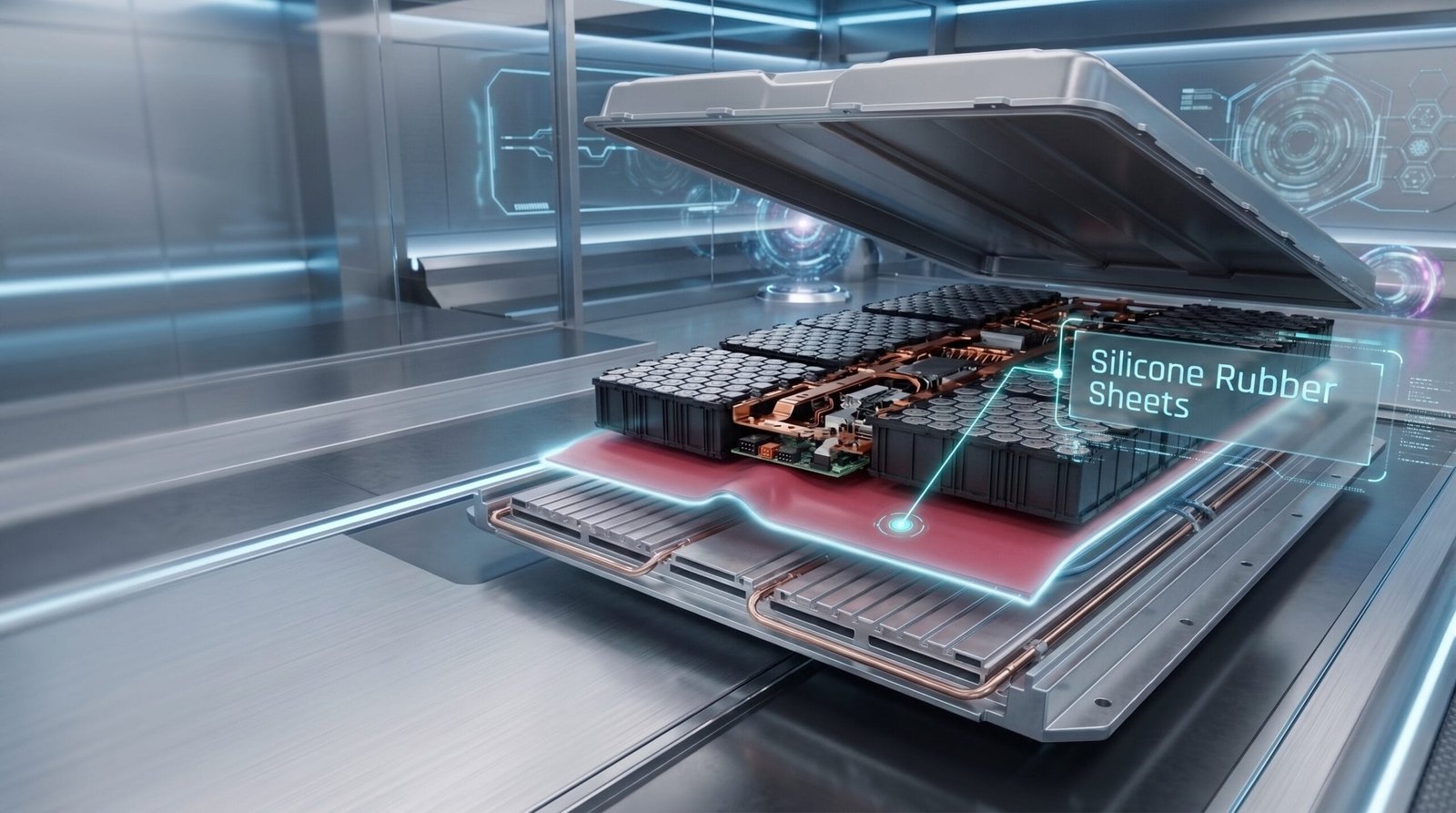
As electric vehicles transition to 800V architectures, silicon carbide (SiC) power electronics, and ultra-fast charging, thermal management has become one of the most critical engineering challenges in battery pack design.
Higher power densities generate greater heat within battery packs, inverters, DC-DC converters, and onboard chargers, where excessive temperatures can reduce efficiency, accelerate component aging, and compromise long-term reliability. Meeting these demands requires materials that dissipate heat efficiently while maintaining reliable electrical insulation under high-voltage operating conditions.
Thermal interface insulating silicone rubber sheets are engineered to perform both functions simultaneously — transferring heat away from critical components while providing high dielectric strength, mechanical compliance, and long-term durability. This guide explores the engineering considerations for selecting these materials in modern EV applications.
Electrical isolation
Blocks leakage current between busbars, enclosures & live cell interconnects.
Thermal transfer
Fills microscopic air gaps to lower interface thermal resistance.
Mechanical compliance
Low compression set keeps contact stable across vibration & thermal cycling.
Why modern EVs need thermally conductive electrical insulation
Higher switching frequencies, compact packaging, and increased power density have significantly raised thermal loads across EV battery systems. Battery modules, SiC inverters, onboard chargers, DC-DC converters, and power distribution units continuously generate heat that must be dissipated to maintain efficiency and reliability.
Traditional electrical insulation materials effectively prevent current flow but often exhibit poor thermal conductivity, trapping heat at the component interface. This increases thermal resistance, creating localized hot spots that accelerate material degradation and reduce electronic component life.
Thermal interface insulating silicone rubber sheets overcome this challenge by combining controlled thermal conductivity with high dielectric insulation — enabling efficient heat transfer while maintaining electrical safety.
Key selection factors
Thermal interface performance
The primary role of a thermal interface insulating silicone rubber sheet is to transfer heat while maintaining electrical insulation. By filling microscopic air gaps between heat-generating components and cooling surfaces, it reduces thermal resistance and improves heat dissipation across battery packs, SiC inverters, onboard chargers, and other high-power EV electronics.
Electrical insulation
Along with thermal management, the material must provide reliable electrical isolation for high-voltage EV systems. Engineers should evaluate dielectric strength, volume resistivity, surface resistivity, and arc resistance to minimize leakage currents and insulation failure in compact battery assemblies.
Mechanical reliability
The material remains compressed throughout the vehicle’s service life, making low compression set essential for maintaining thermal contact and electrical insulation. Engineers should also consider tensile strength, tear resistance, thickness consistency, and dimensional stability during material selection.
Environmental durability
EVs operate under heat, vibration, moisture, UV exposure, and automotive fluids. High-quality silicone sheets retain their thermal, electrical, and mechanical properties under these conditions, helping improve battery reliability and reduce long-term maintenance requirements.
While EPDM and neoprene are widely used for general sealing and gasketing, they are not specifically designed for applications that require both thermal interface performance and high-voltage electrical insulation. In modern EV battery packs and power electronics, materials must efficiently dissipate heat while maintaining dielectric integrity under continuous thermal cycling and mechanical stress — where silicone offers a distinct engineering advantage.
| Property | Silicone | EPDM | Neoprene |
|---|---|---|---|
| Operating temperature | –60°C to +200°C | Moderate | Moderate |
| Thermal conductivity* | Thermally conductive grades available | Limited | Limited |
| Dielectric performance | Excellent | Good | Moderate |
| Compression set | Low | Moderate | Moderate |
| UV & ozone resistance | Excellent | Good | Moderate |
| Thermal aging | Excellent | Moderate | Moderate |
| EV battery & power electronics fit | Excellent | Limited | Limited |
For EV battery thermal management, battery pack insulation, and power electronics cooling, silicone provides a better combination of thermal conductivity, electrical insulation, compression resistance, and long-term durability than conventional elastomers, making it a preferred material for battery modules, inverters, onboard chargers, and other high-voltage EV applications.
Modern electric vehicles rely on thermal interface insulating silicone rubber sheets to manage heat while maintaining electrical insulation across high-voltage systems.
Battery packs
Improve heat transfer between battery modules and cooling plates while providing reliable electrical insulation and vibration damping.
Busbars
Maintain high-voltage insulation and accommodate thermal expansion during continuous charging and discharging cycles.
Battery enclosures
Provide environmental sealing against moisture, dust, and contaminants while supporting battery thermal management.
Power distribution units
Electrically isolate high-voltage connections and help dissipate heat generated by power distribution components.
Inverters & motor controllers
Transfer heat away from SiC power semiconductors while maintaining dielectric isolation and reducing mechanical stress from vibration.
Selecting the right thermal interface insulating silicone rubber sheet requires more than comparing specifications. Material consistency is essential for maintaining reliable thermal performance, dielectric insulation, and long-term durability in EV battery packs and power electronics.
Shin-Etsu’s insulating silicone thermal sheets are engineered to provide thermal conductivity with electrical insulation, making them suitable for applications where efficient heat dissipation and high-voltage isolation are required. Their consistent material properties, dimensional stability, and resistance to thermal aging support reliable performance in battery modules, inverters, onboard chargers, busbars, and other demanding automotive and industrial electronics applications.
Authorized Distributor · India
Sourcing through Pantronics India Pvt. Ltd.
Choosing the right material is only part of a successful EV design. As the authorized distributor of Shin-Etsu in India, Pantronics India Pvt. Ltd. supports OEMs, Tier-1 suppliers, and industrial manufacturers with genuine Shin-Etsu materials, technical product guidance, application support, and reliable supply continuity — enabling engineering and procurement teams to select the most suitable thermal interface silicone solution with confidence.
As EV platforms continue to increase power density, thermal management and electrical insulation can no longer be treated as separate design considerations. Thermal interface insulating silicone rubber sheets provide both efficient heat transfer and reliable dielectric isolation, enabling engineers to improve battery safety, power electronics reliability, and long-term system performance.
When selecting a material, engineers should evaluate thermal conductivity, dielectric strength, compression set, environmental resistance, and compliance with automotive standards. Choosing a solution that balances thermal and electrical performance helps optimize the reliability of battery packs, inverters, onboard chargers, and other high-voltage EV systems.
Frequently Asked Questions (FAQ)
Thermal conductivity, dielectric strength, volume resistivity, compression set, thermal aging, flame-retardant performance, dimensional stability, chemical resistance, and compliance with relevant automotive and electrical standards.

Need help selecting a thermal pad?
Talk to our technical team about gap thickness, conductivity, and electrical insulation requirements for your application.
Mr. Sushil Khandelwal (Thermal Management Expert )
Mail ID: s.khandelwal@pantronicsindia.com